
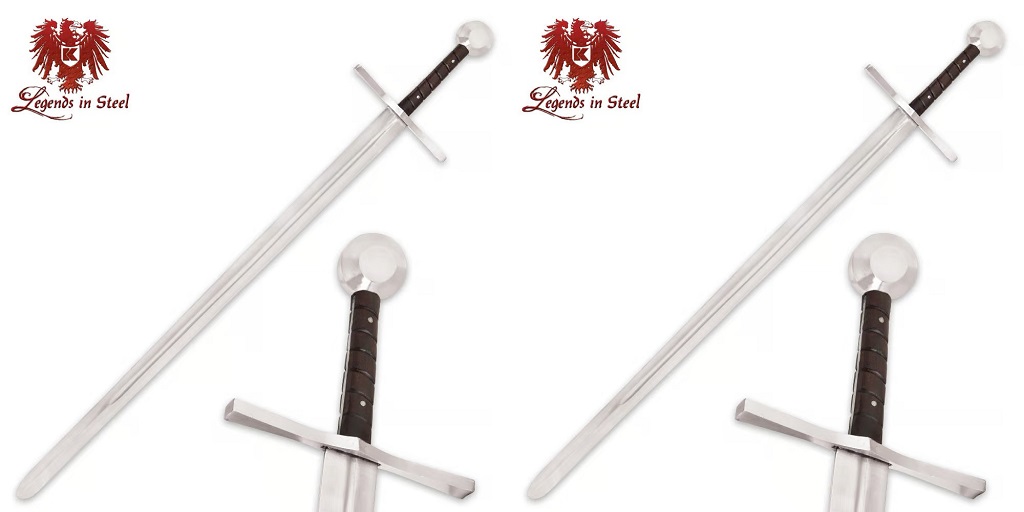
The Knights Templar, one of the most renowned military orders of the Crusades, were famed for their combat prowess and deep devotion to their cause. Their primary weapon, the Crusader sword, was not only a tool of war but also a symbol of their faith and warrior spirit.
Designed for the brutal medieval battlefield, these swords enabled knights to fight effectively against heavily armored adversaries. Examining the design, balance, and effectiveness of these weapons offers valuable insights into how the Templars engaged in combat and survived the harsh conditions of the Crusades.
The Sword Makes the Knight
The Crusader sword, a name associated with the sword commonly wielded by the Knights Templar, was classified as a Type X or XII medieval arming sword according to the Oakeshott classification system. With a blade length of approximately 36 inches, it was ideal for both slashing and thrusting.
Weighing under three pounds, it allowed for easy handling in battle. The blade itself was double-edged and straight, featuring a wide fuller—a central groove that reduced weight without sacrificing strength. The edge was sharp enough for cutting yet durable enough to withstand repeated strikes against chainmail and plate armor.
The sword’s full tang construction, in which the blade extended through the hilt, ensured durability and balance, both of which were critical for knights relying on their weapons for survival.
The materials and forging techniques used to create Knights Templar swords played a vital role in their effectiveness. Crafted from high-carbon steel, these swords struck a balance between hardness and flexibility.
The forging process involved heat treatment and quenching, where the blade was heated and rapidly cooled to harden the steel, followed by tempering, in which the blade was reheated to a lower temperature to reduce brittleness and improve flexibility.
Additionally, a fuller was forged into the blade to lighten it while maintaining its structural integrity. This meticulous process produced a battle-ready weapon capable of withstanding the rigors of war, retaining its sharpness while resisting chipping or breaking.
A Sword Made for Combat
A well-balanced sword was crucial for a Templar knight, as it allowed them to fight effectively for extended periods without excessive fatigue. The ideal balance point was five to seven inches from the guard, enabling both powerful strikes and quick defensive maneuvers.
The pommel, typically made of iron or steel, served as a counterweight to the blade, preventing it from feeling too blade-heavy and ensuring better control. If a sword was too heavy, it could slow the knight’s ability to react and maneuver in battle.
However, the Crusader swords used by the Templars were designed to be both light and fast while maintaining their formidable cutting power. It was a versatile weapon, capable of various combat techniques.
Its broad blade was highly effective for slashing through cloth, leather, and lightly armored foes. When facing chainmail or plate armor, knights relied on precise thrusts to exploit gaps in their opponent’s defenses.
Additionally, the sword was used defensively for blocking and parrying, helping knights absorb enemy strikes while setting up counterattacks. In battle, a Templar knight often paired their sword with a kite shield, which provided both offensive and defensive capabilities.
This combination allowed them to engage in close combat while maintaining protection against enemy blows.
A Religious Symbol
Beyond its practical use in combat, the sword also held profound religious symbolism for the Knights Templar. These swords were often adorned with Christian symbols such as the cross, engraved on the hilt or blade to signify their devotion to the Crusades.
Some swords were even blessed with holy water before battle, reinforcing their spiritual significance. Certain Templar swords featured red garnets embedded in the pommel, representing the blood of Christ.
This religious connection elevated the sword beyond a mere weapon, making it a sacred instrument wielded in the service of God.
The Knights Templar Crusader sword was a masterfully crafted weapon that served both practical and symbolic purposes. It was the perfect tool for the fierce warriors of the Crusades, whether used in battle against enemy forces or carried as a representation of faith and duty. If you want to own a piece of history with a faithfully-crafted reproduction Crusader sword, check out True Swords. They specialize in historical weaponry like this, and have a variety of different blades on hand, including these famous medieval swords.
For more information about Realistic Katana and Real Samurai Sword Please visit: True Swords.
