
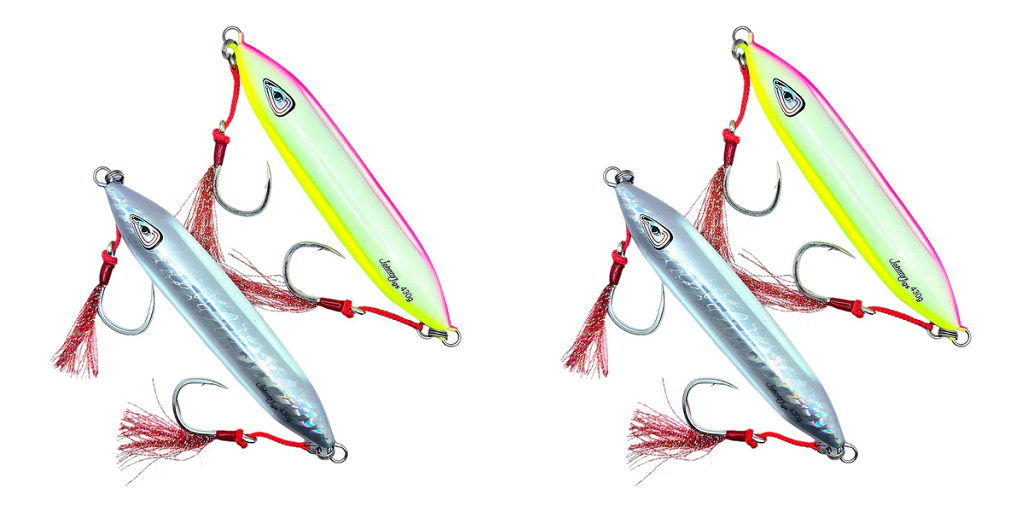
Saltwater jigs, such as AVA diamond jigs, Hopkins Shorty and NO=EQL lures, and Johnny Jigs slow pitch jigs have got to be some of the most versatile lures in the entire realm of angling as a sport.
Not only are they categorically more durable than all other types of lures (in both saltwater and freshwater) but you can do effectively anything with them – drop to the bottom and speed jig, rip them, slow pitch jig them, and a whole lot more.
On that note, here are three specific techniques commonly used with saltwater jigs.
Cast and Retrieve
This technique is commonly applied in the surf as well as in other inshore waters. At its most basic, you’re casting the jig and retrieving it.
There’s a lot you can get into with this, but ultimately you’re simulating a fleeing baitfish and the flash and vibration draw a strike.
One technique is to cast to structure such as pilings and jetties and rip the jig in. Another is to cast into the surf or over a flat and reel with a stop-and-go cadence to impart pauses to the jig.
Both fast and slow steady retrieves can be popular, as can be twitching, stop-and-go techniques as well as “yo-yo” techniques, in which the rod is raised and lowered rhythmically as you bring the jig in.
Speed Jigging
Speed jigging is normally done vertically, so you either need to be on a pier or bridge over deep water, or in a boat.
As in casting and retrieving, speed jigging is best done over structure, although it can also be used to target suspended fish.
Basically, in speed jigging, you drop your lure to the target depth, then reel it up quickly. You can also give it pauses to let it flutter on the drop.
Often, the strike will come at one of those natural pauses in the presentation, as the lure will dart and flutter as it falls, just as a dying baitfish would.
Slow Pitch Jigging
Lastly, we have slow pitch jigging, which has really grown in popularity over the past few years. Like speed jigging, slow pitch jigging is done vertically, but special slow pitch jigs are used, which are flatter and broader than most speed jigs, and which are designed to flutter, spin, spiral, and dart on the fall.
The cadence of slow pitch jigging is also a lot more methodical than that of speed jigging – hence the name “slow pitch.”
Typically, a slow pitch jig is dropped to the desired depth and then the angler deliberately raises and lowers the rod to cause the jig to act lively in the strike zone. This technique can be devastatingly effective on a wide range of both inshore and offshore species.
Your Source for Saltwater Lures
If you’re here for saltwater lures, including but not limited to slow pitch jigs, casting jigs, plugs, and even soft baits, visit Johnny Jigs. They carry a huge assortment of lures and tackle, along with fishing tools – bookmark their page today and stock up before your next offshore trip.
