
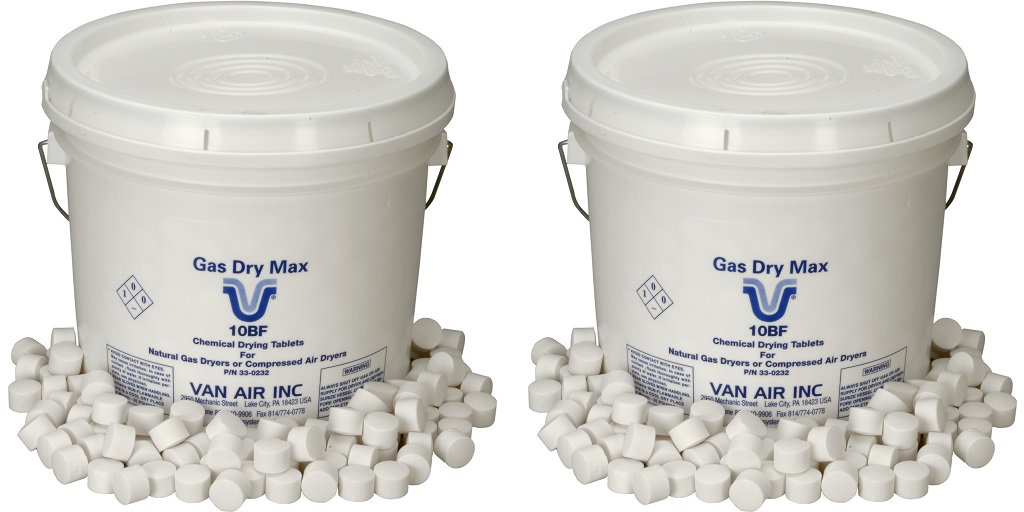
Moisture control is critical in gas systems—but not every environment is suited for traditional desiccant dryers. In remote, high-humidity, or power-restricted locations, it becomes necessary to rely on a more rugged solution. That’s where lithium chloride desiccant, used in single-tower deliquescent dryers like 10BF and Gas Dry Max, proves itself as an efficient and dependable choice for ultra-dry gas applications.
How Lithium Chloride Desiccant Actually Works
Unlike refrigerated systems or regenerating desiccants that need external power, lithium chloride desiccant works passively. In solid tablet form, it’s placed inside a deliquescent dryer where it draws moisture directly from the gas stream. As the solid tablets absorb water vapor, they gradually dissolve into a harmless solution, which is later drained from the bottom of the vessel.
This process—known as deliquescence—is highly effective in reducing water vapor to lower dew points. What sets lithium chloride apart is its aggressive hygroscopic properties. It absorbs moisture more completely than other deliquescent blends, making it a preferred choice for applications requiring ultra-dry results without added complexity.
When to Use Lithium Chloride Desiccant
Lithium chloride is especially valuable in systems where conditions are unpredictable, monitoring is limited, or utilities like power and compressed air are unavailable. Typical uses include:
Natural Gas Pipelines
Moisture in pipelines leads to corrosion, freezing, and flow restrictions. Lithium chloride desiccant helps keep gas streams dry to prevent these costly issues—particularly in cold or coastal environments.
Fuel Gas Drying
Engines, turbines, and burners operate more reliably with dry gas. Lithium chloride ensures fuel moisture is minimized without requiring high-maintenance setups or regeneration cycles.
Biogas Dew Point Control
In biogas treatment, siloxane buildup and water vapor are major concerns. A deliquescent dryer using lithium chloride helps lower the dew point, preserving the integrity of downstream equipment.
Instrument Air and Remote Locations
Even trace moisture can impact sensitive instruments or valves. Lithium chloride desiccant offers quiet, electrical-free operation for instrumentation in remote or classified areas.
Advantages Over Other Desiccant Types
There are many ways to dry gas—but not all options are equal in every environment. Here’s how lithium chloride compares:
Silica Gel
Best for low-flow applications in moderate conditions. However, it saturates quickly in high humidity and is harder to monitor without instrumentation.
Molecular Sieves
Excellent for ultra-low dew points but require energy-intensive regeneration. Best suited for central plants, not field installations.
Deliquescent Tablets (Lithium Chloride)
No power, no moving parts, and no regeneration needed. Ideal for point-of-use, hazardous zones, or utility-free operations. Provides consistent drying until spent.
Safety and Maintenance Considerations
Lithium chloride desiccant is non-combustible, non-pressurized, and suitable for Class I Division 2 environments. Once installed, it requires minimal oversight beyond checking for fluid levels and scheduled replacement of the spent tablets. Drainage is built into the design, and spent solution can be disposed of per local environmental guidelines.
Because the desiccant is contained within the dryer housing, there’s minimal operator exposure, and no active temperature management is necessary—just simple, passive drying.
A Reliable Drying System, Without the Complexity
For teams dealing with remote gas sites, emergency backup systems, or high-moisture industrial processes, lithium chloride desiccant offers reliability without hassle. It’s sold under trusted names like 10BF and Gas Dry Max at Air & Vacuum Process Inc., where desiccant systems are built to perform in the toughest conditions.
Instead of relying on regenerating cycles, pressurized tanks, or refrigeration coils, these systems deliver consistent moisture control—quietly, effectively, and with minimal moving parts.
For operations that demand ultra-dry gas in unpredictable settings, lithium chloride desiccant provides exactly what’s needed: proven performance, built-in safety, and straightforward upkeep.
