Many Lord of the Rings swords featured in the film were inspired by historic weapons, but one specific weapon was designed to specifically reflect a part of England’s ancient past. The design of Herugrim, King Théoden’s sword in The Lord of the Rings films, draws heavily from early medieval Anglo-Saxon weaponry—most notably the renowned sword found within the Sutton Hoo ship burial.
That burial, discovered in Suffolk, England, contained a royal Anglo-Saxon warrior’s grave, complete with a richly decorated sword featuring a pattern-welded iron blade and a hilt adorned with gold and garnets. This archaeological marvel, now housed in the British Museum, profoundly influenced the aesthetic approach adopted by the films’ designers.
Inspiration from Sutton Hoo and Anglo-Saxon Artifacts
The Sutton Hoo sword exemplifies early medieval craftsmanship. Characterized by a stronger, pattern-welded iron blade and a hilt lavishly decorated in gold—some pieces even inlaid with garnets—the weapon was both functional and symbolic.
Its pommel, intricately beaded, bore evidence of wear consistent with actual use, offering profound insight into the hand-to-sword interaction of its owner. This fusion of practical durability and ceremonial beauty became a template for cinematic weapon design .
Translating Archaeology into Herugrim
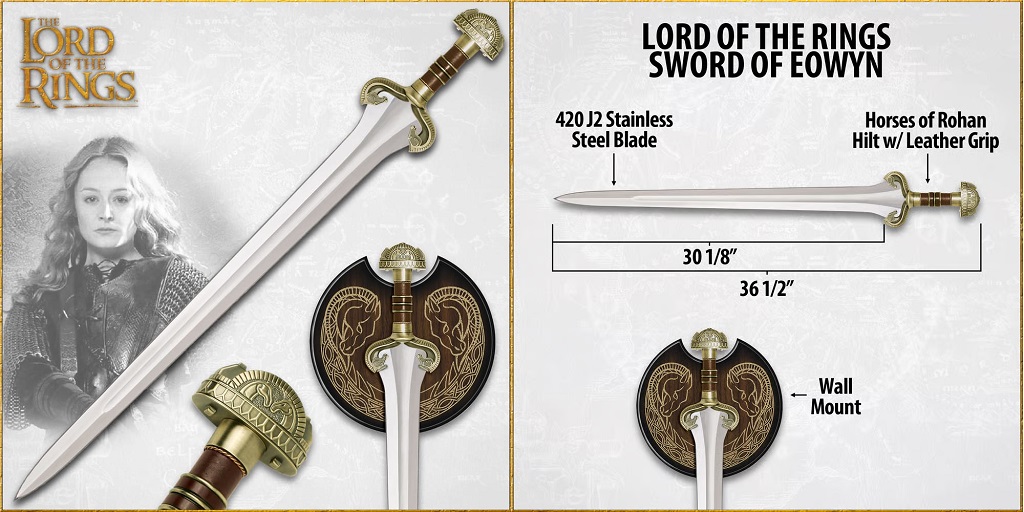
In crafting Herugrim, the designers channeled these archaeological hallmarks: a shaped fuller in the blade, a brass-plated guard and pommel engraved with motifs resembling Rohan’s heraldic horses, and a richly bound leather grip.
Unlike the Sutton Hoo sword’s organic patina, Herugrim is polished to a noble sheen befitting the King of Rohan. Yet the echoes of early medieval design—such as the weighted pommel, functional fuller, and historically inspired guard—remain clear under the film’s more stylized aesthetic .
Specification Highlights: From Screen to Display
The replica of Herugrim embodies these design choices with precision. It features a 27½” heat-tempered 420 stainless steel blade with a wide fuller—adding both structural integrity and visual authenticity.
The antique brass-plated guard presents twin horse heads facing outward, paying homage to Rohan’s symbol and directly drawing from medieval motif work. The wooden plaque, adorned with horse imagery, complements the display of this regal piece.
For collectors seeking heightened realism and functionality, there are Battle‑Forged versions that use 1070 high-carbon steel, forged and fullered for authenticity and strength. With a peened tang, forged brass guard and pommel finished to appear aged, and a genuine leather-wrapped grip, it turns Herugrim from decorative prop to the ultimate film replica.
Distinct Qualities of Herugrim
One of the most striking aspects of these replicas is their balance and ergonomics. Early medieval swords, like the Sutton Hoo find, were functional tools designed for combat. The replicas reflect this with weight distribution and grip texture that accommodate handling—providing a more authentic experience than purely ornamental swords.
The stainless steel version stresses display readiness, while the carbon steel iteration targets heavier handling and longer-term use .
Moreover, the level of detail isn’t merely surface-level decoration. The brass guard’s horse-head motif and patterned pommel are deeply engraved and intentionally stylized, bridging archaeological inspiration with Middle-earth lore.
This layering of historical references and fictional identity ensures Herugrim feels like it exists in its own cultural context—distinct from Hollywood-fantasy clichés.
Why Archaeology Matters in Fantasy Design
By rooting Herugrim’s design in genuine Anglo-Saxon features, the sword gains authenticity and honor—it’s not just an ersatz prop but a believable artifact with real-world analogs. This weaving of Tolkien’s storytelling with archaeological fidelity enriches the visual language of the films and their associated memorabilia.
Rather than mere speculation, Herugrim and other Lord of the Rings swords are anchored in both history and art. It stands as a successful union of archaeological aesthetics and cinematic creativity. This makes Herugrim more than a prop—it’s a tangible echo of both early medieval craftsmanship and fantasy mythmaking.
For more information about Rapier and Sword Cane Please visit: BudK Worldwide Inc.