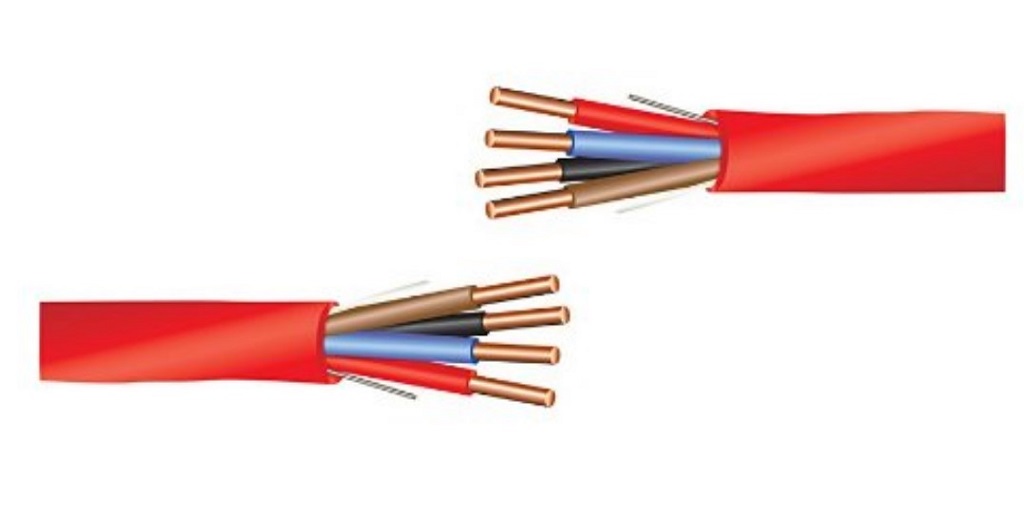
Instrumentation cable, as a class, is a highly specialized category of (usually) low-voltage cables that are designed to provide power and communications for instrumentation and alarm systems.
While they usually don’t have to carry a heavy voltage or current load, the sensitivity and fidelity of the data they carry makes them mission-critical to the circuits they serve, and as such, it is imperative to use only the grades that are suitable for the application.
Case in point: AWG fire alarm cable – how does this vary from other “types” of instrumentation and alarm cables?
On the Differences
First, AWG does not differ in that first designation. AWG simply means “American Wire Gauge” and is a gauge used to determine the cross-sectional thickness of a wire. It is applied to most if not all electrical conductors in North America – not just to fire alarm cables.
However, fire alarm cable does vary in some other key ways. First, and most important, AWG fire alarm cables must be made with special insulation materials. These not only protect the cables, but are fire-resistant. Some are also self-extinguishing, and they must be made from materials so that they do not release toxic smoke when heated.
This protects not only the cables but also the occupants of the buildings in which they are used. They must remain operable under high heat, and they must also not contribute to the risk to those in any building afflicted by fire.
Fire alarm cables must also be very flexible, so that they can be effectively used in tight spaces, although that is not a trait that is necessarily unique to them among instrumentation cables.
Riser and Plenum Rated Cable
AWG fire alarm cables are further subdivided into riser and plenum rated cable.
Riser space is the vertical space in a building that is used for conduits, pipes, and other infrastructure that must communicate between floors. As a result cables intended for riser space are meant to limit the spread of fire between floors. They are fire retardant, but not as fire-retardant as plenum cables (see below).
Plenum space is the space above a drop ceiling or beneath a raised floor, which is usually reserved for the use of air ducts and other HVAC equipment. Plenum fire alarm cable must be made with fire-retardant materials that are much more robust than riser cable because they are used in areas where air circulation equipment is also used.
It is important to recognize the difference as these different types of AWG fire alarm cable should be reserved for use in the applications for which they were intended.
Where to Get AWG Fire Alarm Cable Online
Looking for a new supplier of AWG fire alarm cables? Get it online at EWCS Wire. EWCS Wire carries a wide range of high quality electrical wire and cable, including fire alarm cable and other instrumentation cable, general building wire, bare copper wire, welding cable, marine cable, and many other types. You can learn more on their website or contact them at Sales@EWCSWire.com.