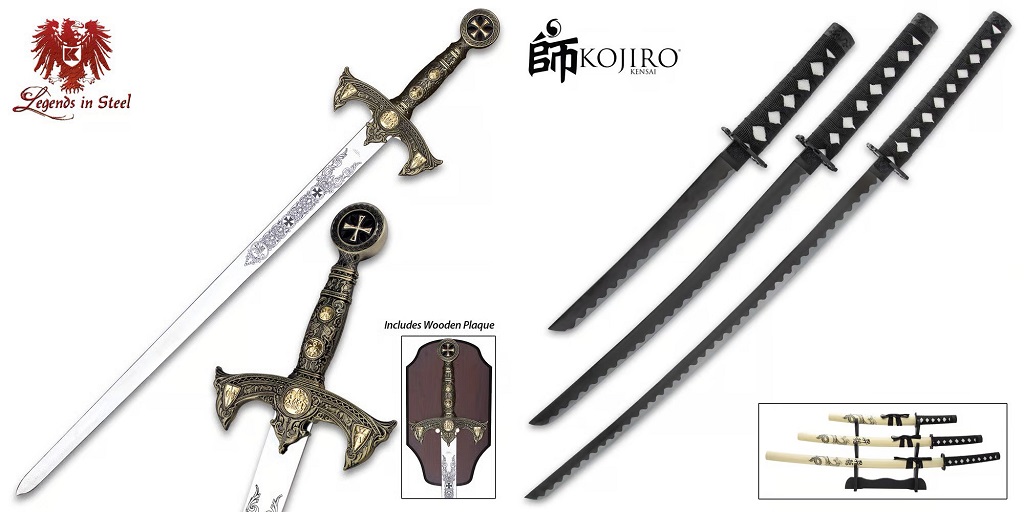
Are you in the market for a real samurai sword? Then you’d better learn quickly what the difference is between a real sword and what we in this industry refer to as a “sword-shaped object.”
Do not be fooled. Despite the fact that real swords and so-called “sword-shaped objects” are visually indistinguishable, they could not be more different.
A Real Samurai Sword Is Made from an Appropriate Steel Alloy
Some steels are suitable for making a sword, and some are not. High-carbon alloys in the 10XX class, like 1045, 1055, 1060 and 1095, can be used to make a real sword, with appropriate tempering.
Other suitable alloys include T10 and Damascus alloys, which utilize multiple grades of steel folded and forged together.
There are some alloys that do not contain enough carbon to provide the right hardness and temper to the blade; these “swords” are likely to bend, chip or snap when struck, which means they are not “real.”
A Real Samurai Sword Has a Traditional Tang (Nakago) Secured with a Mekugi
Sword-shaped objects are sometimes made with what we in the industry refer to as a “rat-tail tang.” A rat-tail tang is a thin strip of steel, typically spot-welded onto the blade stock, that serves as the anchor of the blade to the hilt – in this case, called a tsuka.
Rat-tail tangs are only suitable for making wallhangers. If you strike a sword with a rat-tail tang it is only a matter of time before the blade snaps off entirely at the hilt.
Rather, a real samurai sword is made with a tang (nakago) that is a third to a half the full width of the blade, which like the blade is also tempered, and which is secured in place with a small bamboo pin known as a mekugi.
If it does not have a full nakago secured with a mekugi, it is not a real samurai sword; it is a sword-shaped object.
A Real Samurai Sword Has Been Tempered
Real Samurai swords are tempered using a process called “yaki-ire.” In English, we call this “clay tempering.”
Once the sword’s blade is shaped, it is encased in clay, with a thinner layer of clay along the edge and a slightly thicker layer along the spine. Then, the whole thing is heated in a charcoal forge.
The differential thickness in the clay allows the edge both to heat up and to cool down faster, resulting in a much harder edge that retains its geometry better, even under duress. The spine of the blade heats up and cools much more slowly, resulting in a softer, more resilient spine that can absorb shock better.
The result of this is a hard edge that stays sharp longer, paired with a more impact-resistant spine.
Sword-shaped objects are not only not clay-tempered, they are not tempered at all and will bend or break when used for live cutting practice.
A Real Samurai Sword Has a Legit Hamon
A real samurai sword will have a hamon, sometimes referred to as a hamon line. It is a cloudy, wavy line indicative of the differential hardness boundary between the edge and spine of the blade that is physically created during the process of clay tempering described above.
A real sword’s hamon occurs naturally during the tempering process. A sword-shaped object either will lack a hamon line, or will have a fake one that has been etched onto the blade.
Where to Get a Real Samurai Sword?
Now you should be ready – at least from a high-level – to tell the difference between a real sword and a sword-shaped object.
Here for a real samurai sword? The best place to get battle-ready swords is True Swords. Check out their website and get in touch with them if you have any questions before you buy.