
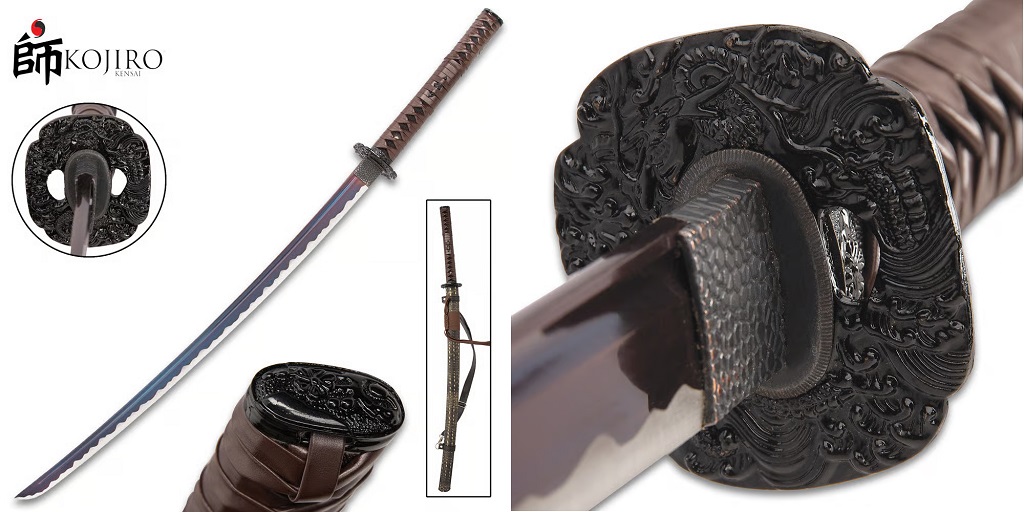
Not all Japanese sword replicas are made alike, and fewer yet are made according to the traditional techniques that lend what might be called, for lack of a better word, a “real samurai sword.”
That being said, here are 5 characteristics of an authentic, traditional Japanese sword like a katana.
It’s Made with Tamahagane
Traditionally, Japanese swords like katana and odachi swords were made with a (relatively loosely defined) grade of steel called “tamahagane” which in English means either “precious steel” or “jewel steel”.
This grade of steel was produced from iron sands harvested in Shimane prefecture, and historically it typically contained between .5% and .7% carbon, though some grades could contain carbon in concentrations of up to 1.5%.
Today, most Japanese sword replicas are not made with true tamahagane, but good grades of steel are nonetheless used to make them, such as Damascus, T10, and 1095.
It Has Been Clay Tempered and Has a Real Hamon Line
A real Japanese sword will be clay tempered, which produces a much softer, more stress and shock resistant spine and a harder edge. This makes the sword able to withstand blows, but gives it an edge that is hard enough that it lasts.
Some modern Japanese swords that are not tempered this way have their hamon line, which demarcates the boundary between the differential temper, etched on, but true, traditionally forged Japanese swords have a real hamon line.
The Saya Is of Lacquered Wood
Traditional Japanese swords have scabbards that are called a saya. Modern replicas may be made of polymers or metal alloys, but traditional Japanese swords still come with real lacquered wood sayas.
The Tsuka Features a Rayskin Wrap
The tsuka, or hilt of a Japanese sword, is typically wrapped with rayskin, which provides a solid grip. Over the rayskin there is some sort of cloth or cord wrap that also improves a wielder’s grip on the sword.
Modern replicas do not always maintain this feature, but high-quality Japanese swords are still made according to the traditional method and still use premium materials.
The Nakago (Tang) Is Stamped
Traditionally, the smith that produces a Japanese sword would stamp some sort of insignia on the nakago, or tang, of the sword.
Normally this is hidden from view, but a traditional Japanese sword that’s forged by a blacksmith will typically still have this calling card. Of course you would need to disassemble the sword and remove the blade from the tsuka to see it, but it is a good way to check to see how “authentic” a traditional Japanese sword really is.
Shop Authentic Japanese Sword Patterns at True Swords
Want to add some traditional Japanese sword patterns to your collection? Start your search online at True Swords. They carry a wide range of traditional Japanese swords, including tanto daggers, katana and wakizashi daisho sets, and even odachi swords.
Check out their collection and get in touch with them for more information, if you have any questions before you buy.
For more information About Samurai Sword Cane and Ax Handle Bat please visit: True Swords.
