
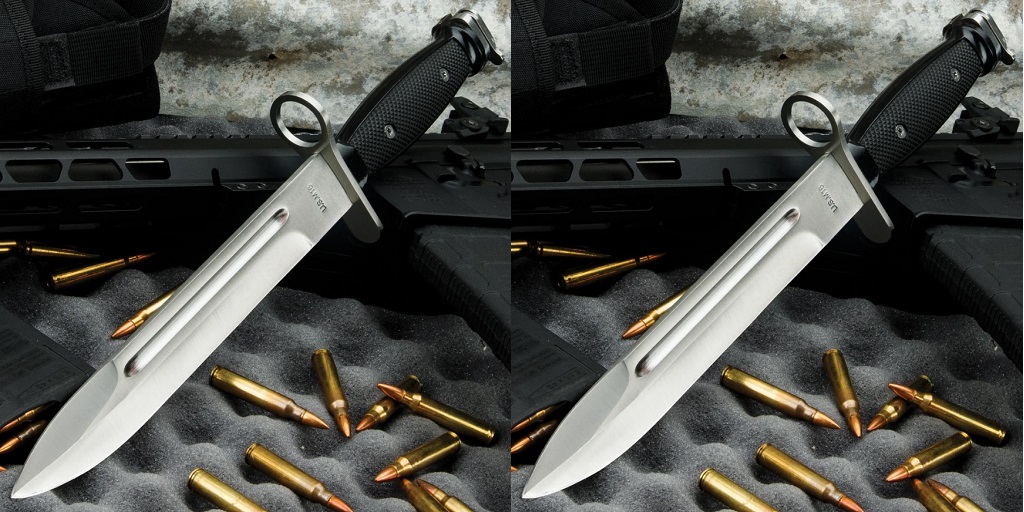
Let’s not mince words. Bayonets are not designed for, and were not intended for, general utility. They were, first and foremost, weapons that were either intended to supplement a firearm’s reach, or, more importantly, to counteract a slow rate of fire or ammo scarcity.
But, beyond the value of collection, there are utilitarian uses of bayonets, assuming you know what to look for and how they can be used. Some are practical as simple tools and others are not. Here’s what you should know.
As Sporting or Utility Knives
While many bayonet designs are too large or unwieldy to be effectively used for utility or sporting applications, such as hunting knives, there are some that are a little more versatile than others.
Modern (or relatively modern) patterns like the US M7 and the USMC M-9 sport somewhat practical profiles akin to a bowie. While they are a bit large, their comfortable handle ergonomics and useful blade profiles enable them to do double duty as hunting, camp or survival knives.
Bayonets like these can be confidently applied to sporting tasks like camp construction, carving tools and camp furniture, general bushcraft tasks, or be deployed as fishing or hunting knives.
Despite their intended use as combat knives, bayonets are often made with high-quality corrosion resistant steels and handle scales that are intended to perform without requiring excessive maintenance. On this consideration alone they are serviceable as sporting knives.
How Bayonets Have Evolved Over Time
The first bayonets were simply knives with small handles intended to fit into the bore of a gun; these were known as plug bayonets but they have not been produced for several hundred years now.
After lug bayonets were developed, the early bayonets were fairly long and some of them lacked a knife’s edge, as they were intended for thrusting maneuvers and attacks. These gave rise to the sword bayonets of the late 1800s, and which were prevalent throughout the early part of the First World War.
Bayonets like these are not effective as sporting or utility tools because they are much too large. For the same reasons that they were largely ineffective in the confines of trench warfare, they are ineffective as camp knives.
Moreover, they mostly have longer, thin blades, and are not well suited to chopping, which is the only thing a larger knife would be good for anyway.
So, if you are looking for a bayonet to use as a tool, stick with a contemporary design and not some historical replica. While it might perform as a sword it won’t perform well as a camp knife.
What to Look for in a Bayonet
As a general rule, look for a bayonet with a blade that’s not too big – between 6 and 10 inches is plenty. Even that’s quite large. You also don’t need a double edge, that limits the utility of the knife and makes it impossible to baton with it.
There are some other features to look for in bayonets. For instance, all else being equal, you’ll want one with a corrosion-resistant steel alloy for the blade and with scales that are low maintenance.
A good, solid sheath that offers sure retention is also something you definitely want. If you can convert the bayonet to a pair of shears using a lug on the sheath, that is even better. Also, some bayonets have sharpening stones incorporated into the design of the sheath.
Where to Get High-Quality Replicas and Reproductions
Whether you’re here because you want a bayonet to add to your collection or because you want to get craft with what you carry in the field, make BudK your first stop. They carry a wide range of replicas and reproductions and most of them at very attractive prices.
