
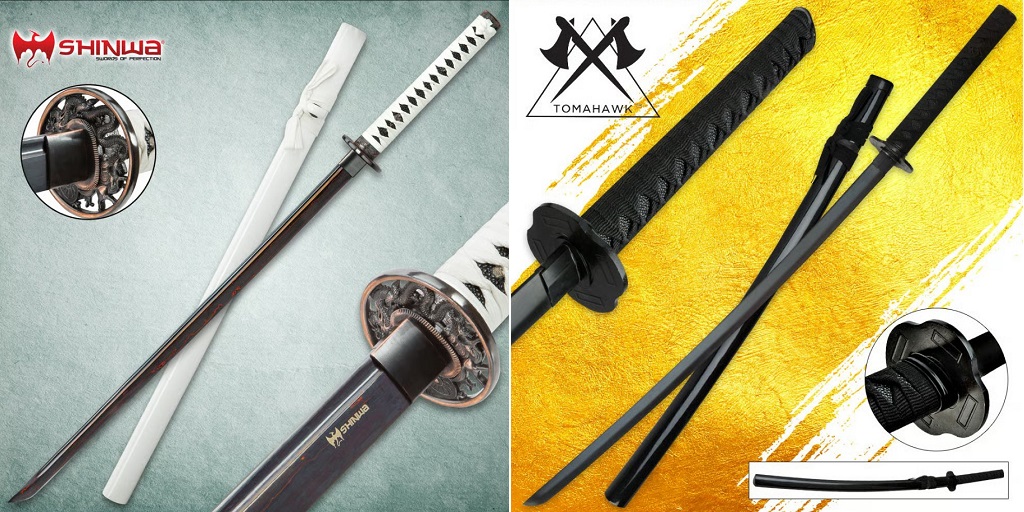
When people picture a Ninja Sword, they often imagine a short, straight weapon carried across the back: sharp, dark, and silent. That image is strikingly different from the elegant curve of a samurai’s katana. Yet the truth behind the ninja sword is layered with mystery, practicality, and even speculation. Unlike the katana of the samurai, the Ninja Sword was a tool of survival, and shaped by necessity, not ceremony.
Function Over Honor
Samurai swords were built as symbols of status as much as weapons of war. For centuries, they were regarded as the “soul of the warrior,” crafted with spiritual reverence and artistic precision.
Ninjas, however, lived in a different world. They operated as spies, scouts, and saboteurs, working in secrecy, not glory. To them, a sword wasn’t a badge of honor; it was a piece of equipment. Because their missions demanded stealth and speed, their weapons had to be practical. The sword a ninja carried wasn’t meant for ritual or display; it was a multi-purpose instrument designed to help them survive, escape, and blend in.
Shape and Structure
The most visible difference between the ninja sword and other Japanese blades lies in its shape. Traditional samurai swords had a graceful curve, a design that allowed for powerful slashing motions. The curve guided the blade naturally through the target during a cut. But that same curvature made thrusting and stabbing less efficient.
The ninja sword, by contrast, was believed to be straight. This wasn’t an aesthetic choice; it was tactical. A straight blade could be drawn and thrust quickly, even in tight quarters or from awkward positions. It also allowed the ninja to use the sword in confined spaces, such as hallways, crawl spaces, or even from beneath floors, the kinds of situations samurai would never face in formal combat.
The average samurai katana measured around 70 centimeters. The ninja sword, however, was much shorter, roughly 40 centimeters, falling between a full-length sword and a short blade. The shorter size made it easier to maneuver through forests, over walls, or in buildings without snagging on branches or architecture. It also made it easier to draw quickly during a surprise encounter.
Hidden Engineering
Beyond the blade, the ninja blade had other distinctive features. The guard, or tsuba, was wider and sturdier than the samurai version. This allowed it to double as a step when climbing walls. The ninja could plant the sword against a surface, step on the guard, and use it as a small ladder.
The scabbard, or saya, was simple and matte black, avoiding any shine that might reflect moonlight. Its end was often pointed, so it could be stuck into the ground for stability when used as a foothold.
In addition to holding the sword, the saya could also store small supplies: medicine, tools, or even messages. This reflected the ninja’s resourcefulness: every object had more than one purpose.
Did Ninja Swords Really Exist?
The most fascinating twist is that historians still debate whether “ninja swords” ever truly existed. There are no surviving examples from the feudal era. The swords on display in museums today were crafted centuries later, during Japan’s Meiji period, mainly for tourists and theater. It’s possible that what we call a ninja sword is more myth than fact. A symbol shaped by stories, movies, and manga rather than battlefields.
Even so, the legend makes sense. The design attributed to the ninja sword fits perfectly with the missions, tactics, and environments ninjas worked in. It’s a believable invention: precise, efficient, and purpose-built.
A Weapon of Imagination and Ingenuity
Whether or not historical ninjas actually carried a distinct sword, the concept captures what made them unique: adaptability. While samurai fought with glory in open fields, ninjas moved unseen, using whatever tools would help them survive.
The ninja sword, straight, short, and silent, embodies that idea. It may not have the artistry of the katana, but it represents something equally powerful: the practicality of survival and the mystery of those who lived in the shadows. Find yours at True Swords now!
