
The swords used by Crusaders during the medieval period were far more than simple weapons. They were emblems of faith, power, and craftsmanship that came to define an entire era of warfare and belief.
Emerging between the late 11th and 13th centuries, these blades evolved from earlier Viking designs into something distinct and symbolically charged. The Crusader sword became both a practical weapon for battle and a sacred emblem representing the Christian cause during the campaigns to reclaim the Holy Land.
The Physical Qualities of the Crusader Sword
The most recognizable feature of a Crusader sword was its straight, double-edged steel blade. Unlike earlier Viking swords, which were broader and featured shallow fullers, Crusader swords were more tapered and agile, designed to pierce through chainmail and light armor.
Their blades usually measured between 58 and 100 centimeters, making them effective for both cutting and thrusting. This balance of sharpness and durability made them ideal for mounted knights or foot soldiers engaged in close combat.
A fuller, an indented groove running along the blade, was incorporated to reduce weight while maintaining strength, ensuring that the weapon could be wielded with speed and precision.
The cross guard was another defining feature. Simple in form during the early Crusades, it evolved into a more ornate and functional component as sword-making techniques advanced. It provided essential hand protection in battle and could be used to trap or deflect an opponent’s blade.
The design of the cross guard, resembling the Christian cross, gave the sword a profound religious symbolism. For Crusaders, this was not merely a tool of war, it was a holy object representing their mission to fight for God and faith.
Over time, cross guards became more decorative, reflecting the growing prestige of knighthood and the influence of the Church on medieval art and weaponry.
The hilt and pommel of Crusader swords also carried deep meaning. Early swords had short, leather-wrapped hilts suitable for one-handed use, often measuring around nine centimeters in length.
As time progressed, longer hilts allowed for a more versatile two-handed grip. The pommel, initially oval-shaped, evolved into various forms, such as the “Brazil nut” and later the “wheel” design favored by many Crusader orders, including the Knights Templar.
Some pommels were engraved or enameled with family crests, the red cross of the Templars, or symbols of faith. These embellishments reinforced the sacred connection between knight, sword, and divine purpose.
What sets the Crusader sword apart from other medieval weapons was the combination of practicality, balance, and symbolism. They were carefully weighted so that the point of balance rested near the hilt, allowing the sword to move as an extension of the knight’s arm.
This balance made the weapon efficient in battle while reflecting the philosophical idea of divine harmony and perfection, a design concept sometimes referred to as “divine proportion.”
A Modern Recreation of the Sword
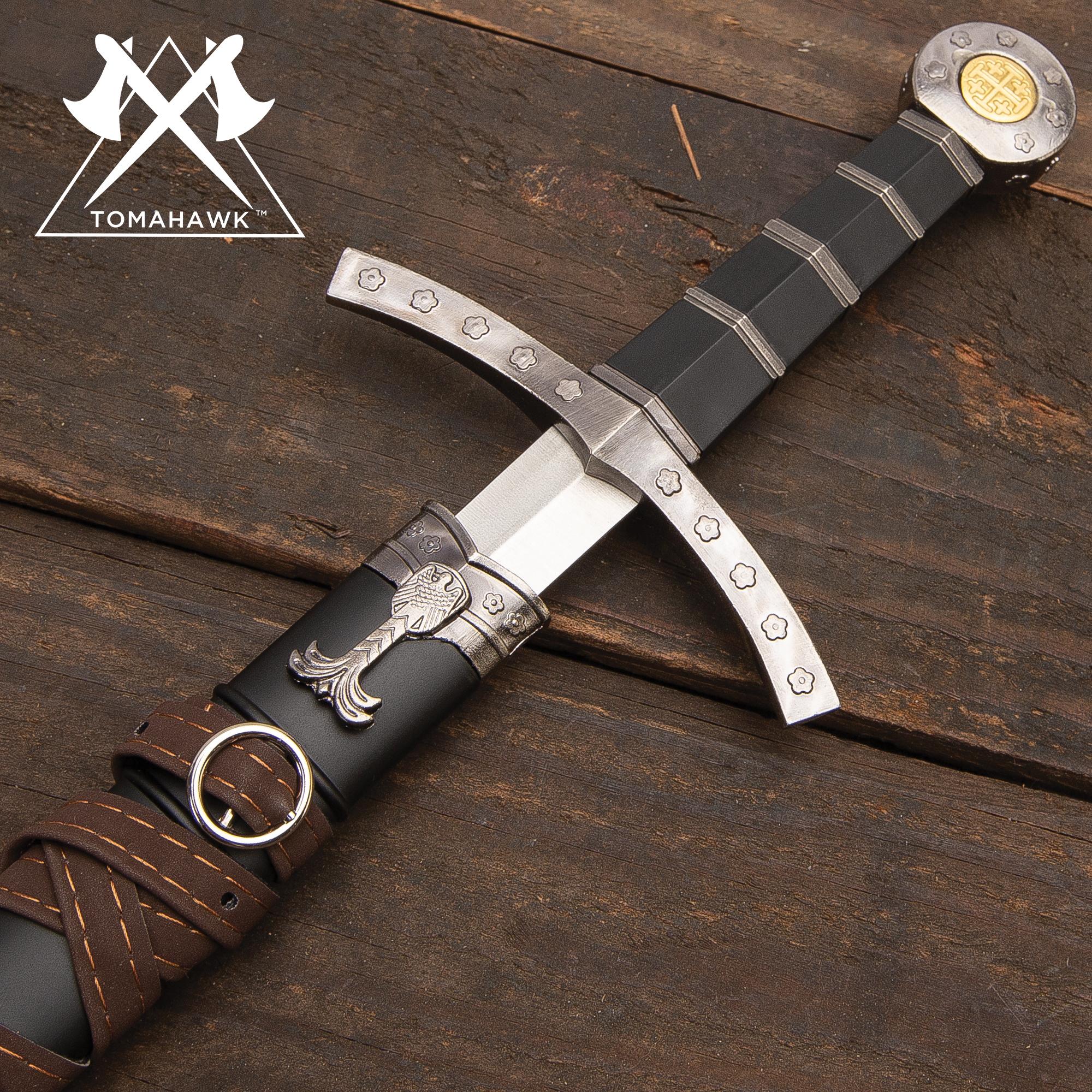
Today, modern reproductions like the Jerusalem Rose Medieval Crusader Short Sword preserve the spirit of these historical weapons. Measuring 22 ½ inches overall, this short sword captures the essence of medieval craftsmanship and the spiritual identity of the Crusader era.
Its double-edged stainless steel blade mirrors the traditional shape of the swords once carried by knights of the Holy Land. The metal alloy guard, adorned with raised rose emblems, pays homage to medieval heraldry, while the Jerusalem Cross embossed on the pommel evokes the faith-driven missions of the Crusades.
The sword’s banded black handle ensures a firm grip, echoing the practical simplicity of historical grips wrapped in leather, while the ornate sheath captures the grandeur and ceremony associated with a knight’s armament.
Though designed today for collectors, reenactors, and history enthusiasts, the Jerusalem Rose Short Sword embodies all the key elements that made Crusader swords legendary: strength, precision, spiritual symbolism, and aesthetic grace.
In many ways, the Crusader sword was the perfect blend of weapon and icon: an object that carried not only the hopes of victory but also the weight of divine purpose. The Jerusalem Rose sword continues that legacy, standing as a tribute to the craftsmanship, faith, and valor that defined one of history’s most enduring symbols of knighthood.
For More Information About Bleach Bankai Sword and Yorichi Sword Please Visit: True Swords.