
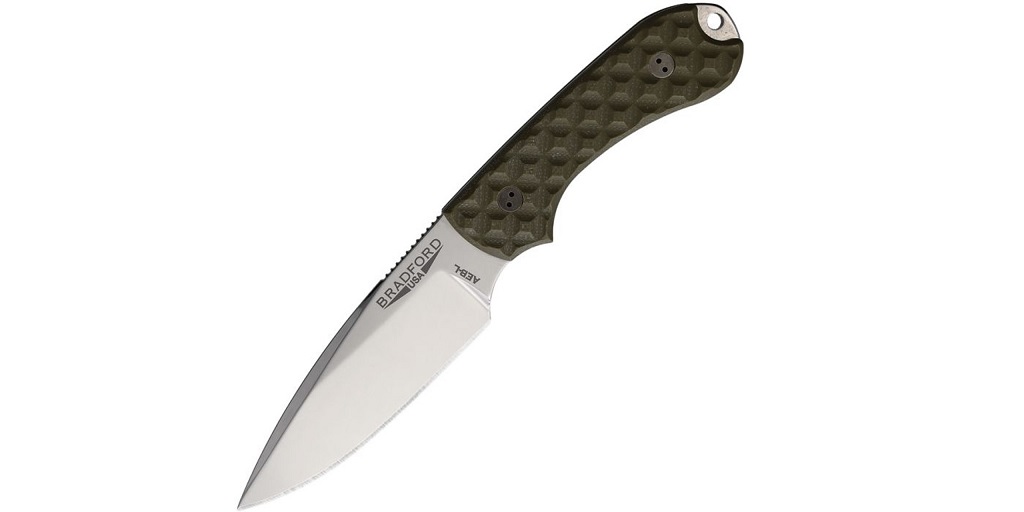
Look at any collection of Bradford Knives including popular models like the Guardian 3 and 3.5 and you’ll see that the company is committed to using a variety of so-called “super steels” that offer a high degree of strength, corrosion, and wear resistance.
But exactly what do these alloys offer? Let’s take a closer look.
AEB-L
Many Bradford Knives are made with AEB-L, which is a non-powder stainless alloy, originally designed for razor blades, which has been around for nearly 60 years now.
So it’s not new, but it does offer some serious performance. Investigating a chemical breakdown, it contains about .67% carbon, 13% chromium, .6% manganese, and .4% silicon.
The concentration of carbon allows AEB-L steel to take a heat treatment for superior hardness and edge retention, while also boosting tensile strength. Carbon also improves wear resistance.
Chromium has the potential to improve tensile strength and, where it forms carbides, it improves hardness, but its main virtue lies in its ability to help boost the corrosion resistance of this alloy.
The other two additions are somewhat unique. As for manganese, that element improves both strength and hardness. Carbon is the key driver here but manganese provides a key assist and makes the steel even harder.
As for silicon, it’s an element commonly added to steel alloys in trace amounts and which improves both strength and heat resistance slightly.
All in all, AEB-L offers good hardness and edge retention paired with very good corrosion resistance. Moreover, AEB-L, despite its high hardness and toughness scores, remains fairly easy to resharpen.
This has to do with the very fine carbides in the steel structure, which facilitate the production of a keen edge, even with basic tools.
N690
N690 is another alloy that Bradford Knives commonly employs in its models, this one, like AEB-L, also considered by most enthusiasts to be a super steel.
Also known as Bohler N690 as a result of the company that produces it, this steel alloy contains far more carbon than the predecessor, at 1.08%, along with 17.3% chromium, 1.1% molybdenum, 1.5% cobalt, .4% of manganese and silicon, each, and a smidge of vanadium, at .1%.
The elevated carbon content makes it even better at maintaining a heat treatment and holding an edge, and the high levels of chromium in this case also make it, like AEB-L, excellent at resisting corrosion – perhaps even better.
As in the former alloy, silicon increases strength and heat resistance, and manganese improves hardness.
There are several other additives here, though. One is molybdenum, which increases hardness, wear resistance, strength, and toughness. Another is cobalt, which also forms carbides and increases hardness.
Last but not least is vanadium, a dense element which, even though it is present in low concentrations, refines grain structure and can substantially improve toughness, wear-resistance, and edge retention.
The interesting thing about Bohler N690 is that, even with the elevated carbon content, it, like AEB-L, also exhibits a very fine carbide structure that keeps the alloy relatively easy to sharpen.
All in all N690 is hard, tough, wear and corrosion resistant, and holds an edge without being a bear to resharpen.
Where Can You Learn More About Bradford Knives?
Want to learn more about the specifications of Bradford Knives like the Guardian series, and the steel and handles scales from which they are made?
Take a look through the catalog of Bradford models online at White Mountain Knives. They not only offer competitive prices, they also offer free shipping on orders in the United States.
