
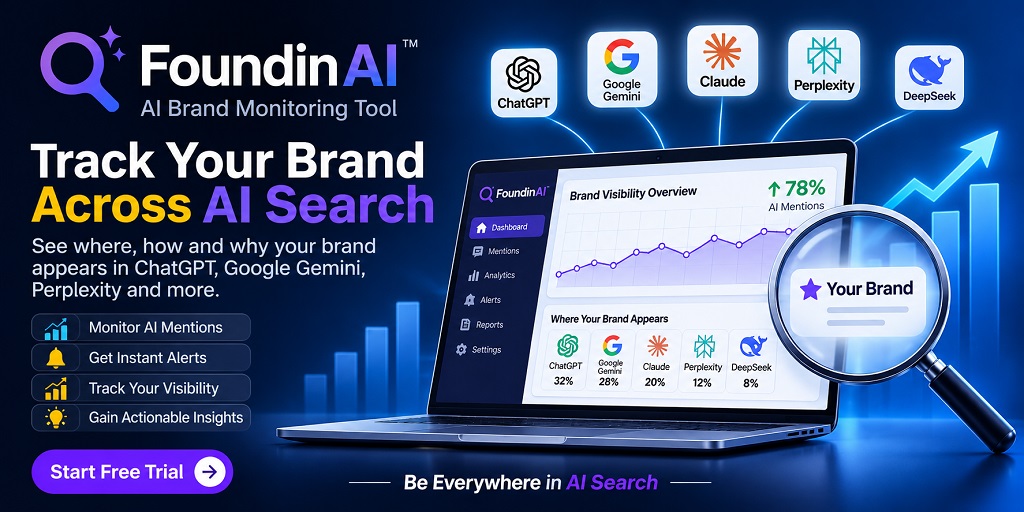
- An AI brand monitoring tool runs a fixed set of customer questions through ChatGPT, Gemini, Claude, Perplexity and Copilot, then records whether your brand is named, cited or missing.
- Track four signals: mention rate, citation source, sentiment and competitor share of answers.
- Answers change between runs, so sample each prompt several times and review weekly.
- Monitoring only pays off when gaps become published content.
What an AI Brand Monitoring Tool Does
An AI brand monitoring tool tracks how often AI assistants mention your brand, which sources they cite and how they describe you. It replaces rank checking with answer checking, because AI platforms return a written response rather than ten blue links. Each response either includes your brand or sends the buyer to a competitor.
Traditional listening software scans social posts, news and reviews. An AI brand monitoring tool queries the models directly. That matters because Pew Research Center found that users who see a Google AI summary click a traditional result in 8% of visits, versus 15% without one. The answer itself has become the place where brands win or lose attention.
Traditional Monitoring vs an AI Brand Monitoring Tool
FactorSocial and Media ListeningAI Brand Monitoring ToolData sourcePosts, news, reviewsLive answers from AI modelsCore metricVolume of mentionsShare of answers naming your brandInputBrand keywordsCustomer questions (prompts)ConsistencyFixed posts you can revisitVaries by run and by modelActionRespond or reportPublish content that fills answer gaps
How to Track Brand Mentions Across AI Platforms
Follow this five-step process to build a reliable baseline in 2026.
- Build a prompt set. Write 25–50 questions real buyers ask, covering comparisons, “best of” queries and problem-led searches.
- Cover five platforms. Run every prompt on ChatGPT, Gemini, Claude, Perplexity and Copilot. Each model draws on different sources.
- Repeat each prompt. Run it three to five times. A single answer is an anecdote, a repeated sample is a rate.
- Log the outcome. Record mention, position in the answer, cited URL, sentiment and which competitors appear.
- Compare weekly. Model updates shift results, so a weekly trend line beats a one-off audit.
Metrics an AI Brand Monitoring Tool Should Report
- Mention rate: the percentage of prompts where your brand appears.
- Citation share: how often your own pages are linked as the source.
- Sentiment and accuracy: whether descriptions of pricing, features and positioning are correct.
- Competitor win list: every prompt where a rival is named and you are not.
The competitor win list is the most useful output. Each entry is a specific question with a specific missing answer, which turns monitoring into an editorial backlog. Official guidance on how generative features pick sources is documented in Google’s AI features documentation for site owners, and its core advice is clear, helpful, accessible content.
From Monitoring to Fixing Gaps
Reporting alone leaves the problem in place. When an assistant recommends a competitor, the fix is a page that answers that exact question better: direct opening answer, named specifics, clear structure. Found in AI – AI SEO follows this loop. It asks five AI tools the questions customers ask, finds each one a competitor wins, then writes the answer and publishes it on WorkspaceCMS, WordPress or BigCommerce, or delivers the finished article for any other site.
AI Brand Monitoring Tool: How to Track Brand Mentions Across AI Platforms FAQ
What is an AI brand monitoring tool?
It is software that submits customer-style questions to AI assistants and records whether your brand is mentioned, cited and described accurately, compared with competitors.
How often should I check AI brand mentions?
Weekly. AI answers vary between runs and shift after model updates, so weekly sampling of three to five runs per prompt gives a stable trend.
Which AI platforms should I monitor?
Start with ChatGPT, Gemini, Claude, Perplexity and Copilot. Each uses different training data and retrieval sources, so your visibility often differs by platform.
