
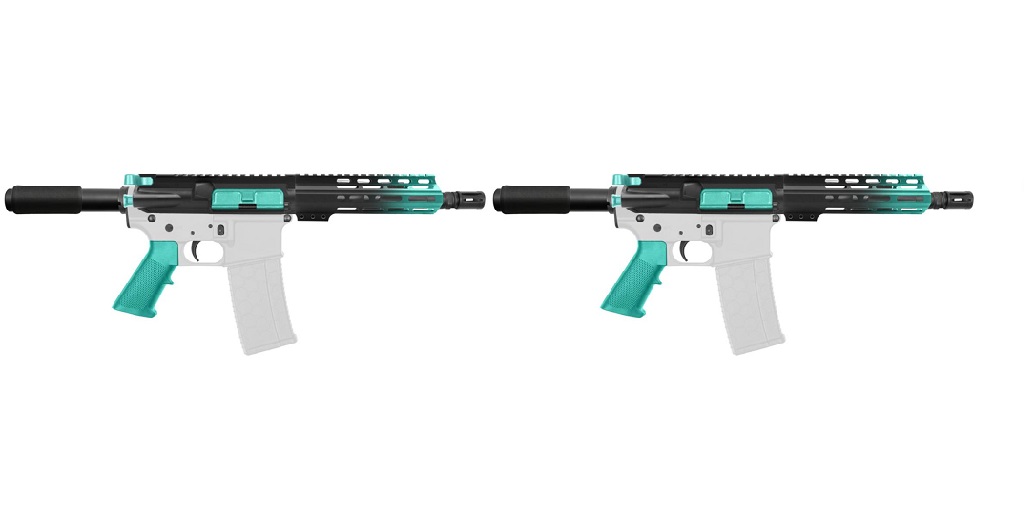
In the market for an AR pistol and thinking of building it yourself? In that event, you should take some time to think about barrel length, which is one of the most important aspects of the build.
Barrel length impacts muzzle velocity, handling, and overall footprint, among other things. Here are the main things to know before you buy an AR pistol build kit.
- 5 inch barrels: Among the shortest of all barrels for AR pistols, a build with a 5 inch barrel will offer handgun-like handling, very low weight, and superior concealability. Since they result in the smallest builds, they are also the best in close quarters. However, the extremely short barrel also doesn’t allow the propellant enough time to deflagrate in the chamber, and what often results is that these shorter builds produce a lot more fouling.
- 5 inch barrels: Bumping up to a 7.5 inch barrel from a 5 inch will offer you a few more feet of muzzle velocity. Also, while 7.5 barrels don’t result in builds that are quite as compact as those made with 5 inch builds, they still handle well, particularly in close quarters.
- 10 inch barrels: An AR pistol build kit with a 10 inch barrel will produce an AR pistol that’s on the larger side, bordering on carbine territory. These larger barrels don’t offer the same handling and maneuverability as their smaller counterparts, but they offer much more power. They also may not produce as much fouling as build kits with smaller barrels.
There are other barrel sizes, but with most AR pistol build kits, these standards are among the most common.
Also the general maxim here holds true: the longer the barrel, the more muzzle velocity the round will have, but the heavier and larger the build will be. The shorter the barrel, the more maneuverable the platform will be, at slight expense of muzzle velocity.
If You Want to Make the Build Even Shorter…
While the barrel contained within an AR pistol build kit is going to have the biggest impact on the overall length of the build, there are other things you can do to shrink down the size even more.
- Be muzzle attachment conscious: Some muzzle attachments are notably longer and bulkier than others. Consider a suppressor for instance, which will add both weight and quite a bit of length to the barrel. Some build kits will come with flash hiders, but you might want to ditch even these if you want to go ultra-compact. Just make sure to install some thread protectors on your muzzle if you do remove the device.
- Get a micro buffer tube: Full-size buffer tube systems and AR pistol build kits don’t mix. But there are still things you can do to shrink the buffer system even further, which will cut back more on the overall size. Consider getting a micro buffer tube, such as one of the options sold by MCS Gearup, in order to shrink the build further.
- Go bufferless: You also have the option of building with a bufferless upper that uses blowback operation to cycle the action – the lack of a buffer tube on the build will considerably shorten the overall length of the build and result in a more compact overall footprint.
Where to Explore AR Pistol Build Kits
Considering getting an AR pistol build kit? Take a look at what your options are over at MCS Gearup. They carry a wide range of build kits as well as parts that you can use to customize your home build along the way.
