
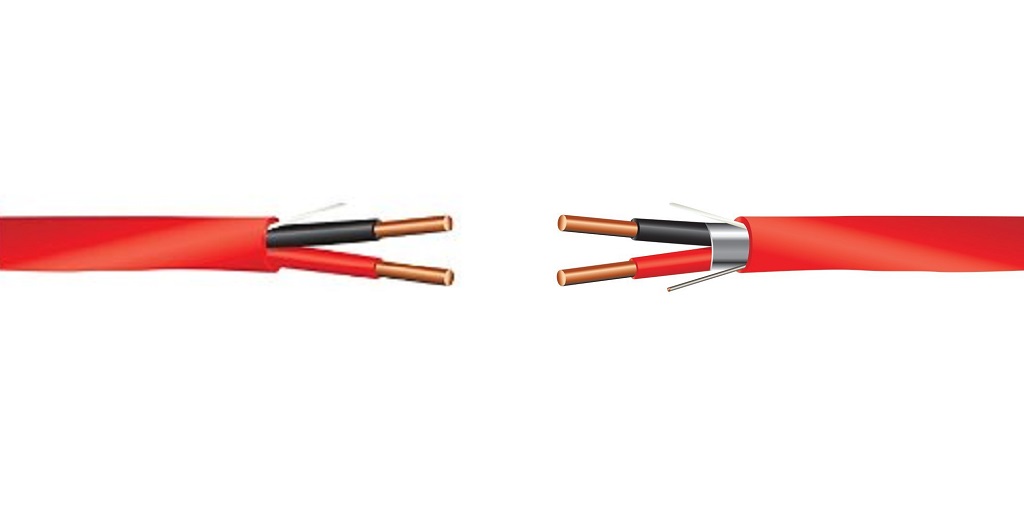
Looking for fire alarm cable for a project, or just need to put a new supplier in your rotation? We have the basic information associated with fire alarm cable along with everything else you need. Here’s the low down.
What Is AWG in Fire Alarm Cable?
AWG in fire alarm cable is the same as it is in all other electrical conductors. Short for “American Wire Gauge,” AWG is simply an inversely proportional logarithmic system used to measure the diameter of an electrical wire or cable.
The higher the AWG the thinner the wire, and the lower the AWG the thicker the wire. It’s important to recognize this as thicker wires can handle heavier current and voltage loads than thinner wires.
But don’t get too lost in the weeds. Just make sure you get a wire that is appropriately rated for the job at hand.
What’s the Difference Between Riser and Plenum Rated Cable?
Riser space is the space in buildings that communicates between the levels or floors. Plenum space is the space above a drop ceiling, or less commonly, below a raised floor, that accommodates extra room for HVAC ductwork and equipment.
Since plenum space is involved in air circulation on the floor it affects, it is critical that the fire alarm cable used there does not burn, self-extinguishes, and produces little to no toxic smoke when heated. Similar but slightly less stringent standards are applied to riser-rated cable.
As a result, it is advisable only to use plenum-rated cable in plenum space and riser-rated cable in riser space.
What About Power Limited vs. Non-Power Limited Cable
Power limited cables are those that are intended to be used in systems where power entry is limited, thereby preventing damage to the system. This is the case because fire alarm cable, like other instrumentation and alarm cables, operates at very low voltages and can easily be overloaded and thereby damaged by high voltages or spikes.
Non-power limited cables are thereby suitable for general fire alarm installation and other purposes, according to the National Electric Code.
What’s Shielding?
Shielding is basically a metal foil or sheath that surrounds the conductors in a fire alarm cable. The purpose of shielding is to protect the conductors within against EMI, or electromagnetic interference.
EMI can be natural or manmade in origin, but the effect is the same; it scrambles electronic signals, and so very high EMI can basically incapacitate a fire alarm system (or any instrumentation, alarm, or communication system, for that matter).
Therefore, it is advisable to use shielded cables in any area in which there is a high degree (or risk) of electromagnetic interference.
Where to Get Quality Fire Alarm Cables
Here for high-quality fire alarm cable, or other electrical wire or cable? VIsit EWCS Wire. They carry a wide range of speciality electrical wire and cable, including but not limited to solar panel cable, aluminum wire, marine battery wire, flexible welding cable, building wire, and bare copper wire. Visit their website for more information or get in touch with them directly if you have questions.
