
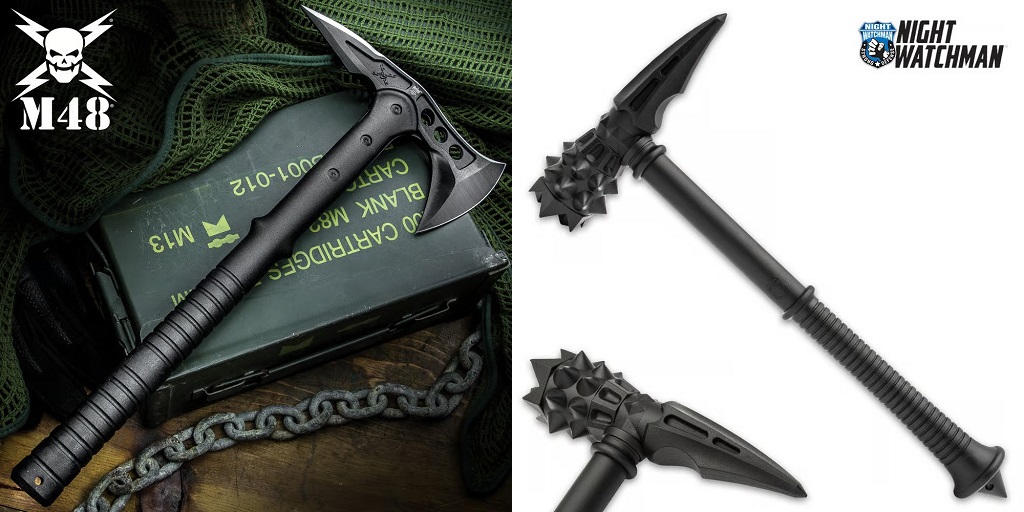
An axe’s “blade”, more appropriately referred to as the bit (hang in there if this is your first foray with axes) is the forward portion of the head that is sharpened. Some axes have two bits (‘blades”) but otherwise the back of the axe is called the poll.
Like any bladed tool, axes require some special notes for care and attention to ensure that you don’t damage them, as well as that they last. Here are some high level notes for a few things you shouldn’t do with your axe.
Don’t Swing It Into the Ground
This is not just advice not to generally stick your ax blade into the ground (that’s just as bad) but specifically what is meant here is that if you’re splitting wood, make sure you never do it over bare earth.
Always stack your wood on another round or chopping block, preferably made of wood (such as another level stump) that will catch your axe bit as it passes through the round your splitting.
Earth, even soft, muddy earth, will dull your axe bit and can leave salt deposits on it that will accelerate corrosion. It’s best not to let your axe bit contact the ground at all.
Don’t Leave It Unsheathed
Probably the simplest advice in this whole post. Woodsmen have a saying – unsheathed axes tend to bite.
Therefore, keep your axe sheathed. And if you don’t have a sheath with you and you’re outside, whenever you’re not handling the axe, strike the bit into a nearby stump – that will keep it covered, protecting both the tool and you.
Don’t Forget to Sharpen and Oil It
Depending on the style of axe head, the grind, and what you intend to use it for, it might not be that big of a deal not to obsessively sharpen it. Splitting axes and mauls, for instance, tend to have fairly obtuse, dull bits.
On the other hand, though, and this is where this maxim comes into play, are limbing and felling axes, which are commonly kept razor, or near-razor sharp. These should be kept as sharp as possible because a dull axe is more likely to deflect, causing injury, whereas a sharp axe will stick where it strikes.
Secondly, remember to oil the whole axe head, not just the bit, periodically. A synthetic machine oil will work just fine.
The reason for this is that most axe heads are not made with corrosion-resistant steel alloys, and the oil will help insulate and protect the axe head from corrosion.
Don’t Neglect Haft Care
The last suggestion here has more to do with the haft of the axe than its blade, but it is important nonetheless.
One, if your haft is wood, get a leather collar and place it around the haft of the axe near its throat. This will help protect the haft from overstrikes.
Second, if the haft is wood, make sure you periodically oil it. Machine oil will not work here; you need something specifically designed for wood treatment, like boiled linseed oil.
Oil keeps the wood from swelling and warping by filling the pores; it also helps protect the wood against moisture absorption and the rot that can follow it.
Here for a New Axe or Blade?
Hopefully you found the basic pointers in this article useful. If you’re here for a new ax or blade, visit True Swords. They carry a wide range of axes and other swords (many of them battle ready) at surprisingly competitive price points. Plus, their collection contains a wide variety of fantasy swords for cosplay users, alongside historically interesting patterns. For a sword enthusiast, there’s a lot to discover on their website.
