
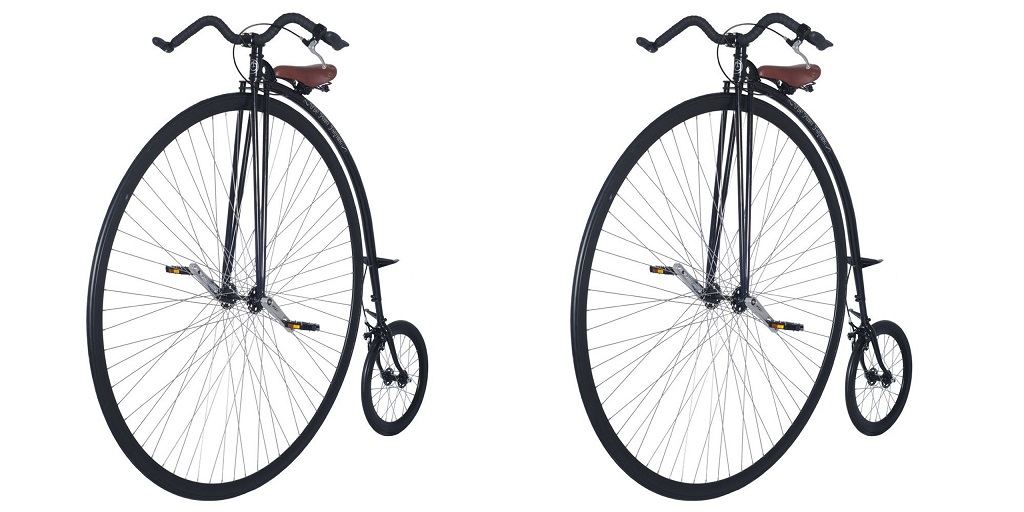
For those of you that are dedicated riders of those bicycles with big front wheels, you probably already know the proper name is a penny farthing, or a penny farthing bike.
You might not know there are some solid tips and tricks associated with handling them appropriately, in this specific instance, braking them appropriately.
This short article will address just that.
Put Pressure in the Right Place and Brake Gradually
The thing about penny farthing bikes is that most of them have brakes that communicate with the rear wheel.
That is, when you hit the brake, it clamps down on the rear wheel. That’s good, in theory, there are just a few problems.
One is that most of your center of gravity will not just be high, it will be very high, and way over the front wheel.
The other is that your center of gravity will be far forward, not over the wheel that’s actually getting told to slow down.
This creates a pointed issue, namely that penny farthings are wont to skid when they are braked, even when they aren’t braked aggressively.
There is however something you can do about this unfortunate circumstance. Many penny farthings have pegs located on the rear fork over the rear wheel.
Before you brake, you can gently reposition yourself so that you are out of the saddle and standing over the rear wheel on this fork.
Then, when you brake, brake gently, and you should experience more favorable circumstances if only for the fact that your center of gravity has shifted to put more pressure directly over the tire that’s getting braked.
Many penny farthing riders find that this improves their braking efficiency, helps slow down the bike faster, and also helps prevent another misfortune known as “taking a header” (more on that in a moment).
…Or Better Yet, Don’t Brake
Alternatively, there is a school of thinking among penny farthing specialists that suggests you should not brake at all.
In their minds, the brake is there as an emergency backup, but for all intents and purposes, it should remain unused.
These riders like to finesse the bike. They see where they’re going and make judgments well ahead of time as to their speed and trajectory so that they can coast to a stop without having to use the brake.
Try this if you ever get a chance. It is a hard skill to master but one that can prove well worth it.
Taking a Header
This article would like to offer one note on a matter of importance just mentioned, and it is the phenomenon known as “taking a header.”
Taking a header occurs when you are riding a penny farthing and either hit an obstacle, stop short, or brake too hard. The bicycle either stops or experiences a deceleration violent enough to pitch you forward right over the handlebars. That is, as you can imagine, where the unfortunate name comes from.
Braking while standing over the rear wheel helps prevent taking a header before it gets you out of the saddle and lowers your center of gravity. This is another reason why the tip in this article might prove helpful.
Where to Get One of Those Bicycles with a Big Front Wheel
Hopefully you found the suggestions in this article to be helpful, but if you’re here because you’ve never ridden a penny farthing bike before and would like to know what it’s like, you can get one online at Unicycle.com. Never mind the name; they carry bicycles with big front wheels too. Check out their website or get in touch with them directly to learn more.
