
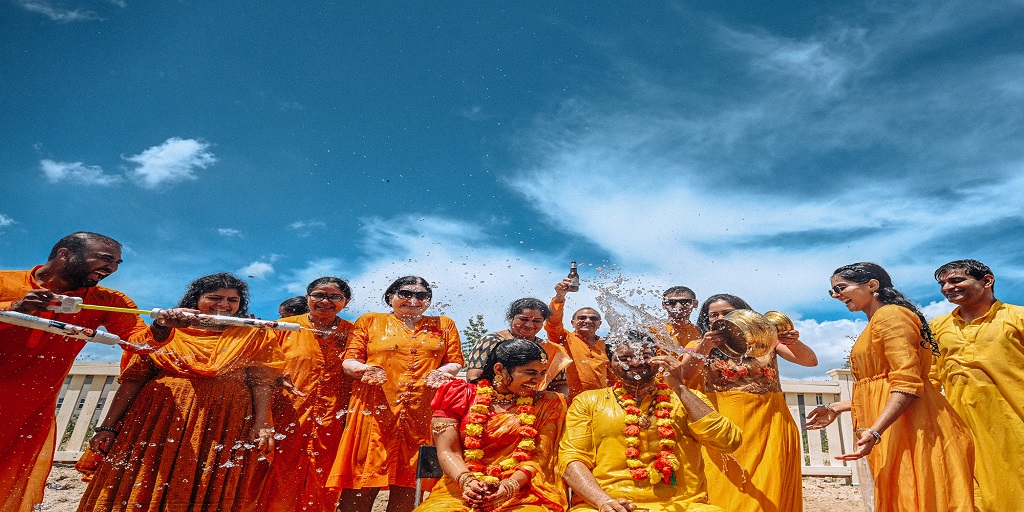
Think of Indian weddings and what swarm your mind are grandeur, deep emotions and vibrant traditions. Every ceremony that is part of an Indian wedding reflects the rich cultural heritage of the land. The rituals that you find in these marriage ceremonies are beautiful, meaningful and highly symbolic. Now the challenge before Indian marriage photography is to capture these moments while retaining the spirit of the entire experience. To do this, what you require is not just the technology and skills, but a deep understanding of the aspects surrounding the Indian marriages. While it is important to ensure that no moment is left without being documented, here is a guide to Indian marriage photography on the must-have shots of the different components of an Indian wedding.
The Pre-Wedding Festivities: Mehendi and Haldi
The pre-wedding celebrations are replete with a lot of fun and joy. The entire experience is meant to set the tone for all the main events that will follow. One of the most visually appealing events during this phase is the Mehendi Ceremony, where intricate henna designs are applied to the bride’s hands and feet. The must-have shots from the Mehendi ceremony are close-ups of the bride’s mehendi design, candid pictures of the family members applying mehendi, and the expressions in the bride’s face as she marvels at the art work.
The Baraat: The Groom’s Grand Entrance
The groom’s arriva to the wedding venue is known as the Baraat. This is a lively event with the buzz created by music, dancing, and excitement. The groom arrives in a traditional style, usually on a decorated horse, car, or an elephant. Some essential shots of this phase are some wide shots of the baraat procession and close-ups of the groom as he is immersed in the mood of the event and festivities. Also, do not miss out the shots of family members and friends dancing with joy, and the groom’s first glimpse of the bride’s family.
The Bride’s Grand Entrance
The entry of the bride is perhaps one of the most emotional moments of any Indian wedding. In majority Indian weddings, the bride is accompanied by her brothers, friends, or parents. In her finest costumes, the bride walks towards the mandap or the wedding altar and photographers must not miss out capturing the first glance first glance of the groom when he sees his bride. Some breathtaking moments of this phase are the emotions on the bride’s face and the reactions of the guests. In fact, this is one of the key moments to preserve for nostalgic remembrance.
The Wedding Ceremony: Rituals at the Mandap
Indian wedding ceremonies are a rich blend of diverse customs from across the different regions of India. However, some rituals are very common among all the different local traditions. An iconic moment is the Jaimala, where the couple exchanges garlands. The other notable moments include the Sindoor (vermillion) application, Mangalsutra (sacred thread) tying, and the couple’s Saptapadi (seven steps around the fire). Close up shots of these rituals is essential, since they form the heart of the wedding. Don’t miss out to photograph the couple’s expressions during all these intimate moments and while receiving the elders’ blessings.
Conclusion
Indian marriage photography must not only document the rituals, it must focus on capturing the emotions, colors and traditions that make up the entire episode of Indian weddings. Every wedding ceremony offers a great experience to create timeless memories. An experienced Indian marriage photography professional will ensure that none of the most wonderful aspects of Indian weddings are missed out and a bundle of fond memories are documented digitally to be preserved for a lifetime.
