
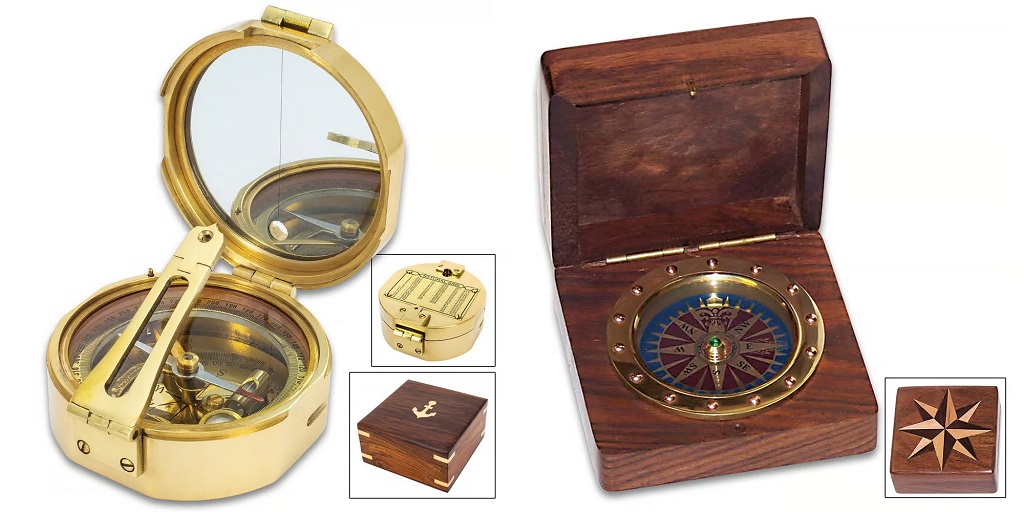
Most of us, given a compass, will just whip the thing out, see where north is, and then set a rough header.
That works, and it works well enough, in some situations. But survival compasses are tools that can be much more precise than this in their utility.
Specifically, lensatic compasses offer a great deal of value – that is, if you know how to use them.
The first step is to make sure you have a lensatic compass – this is the type used by the military, that has a cover with a wire stretched across it, as well as a small lens (hence the name).
Hold the compass up and level with your dominant hand; open the compass and use the thumb ring (and your thumb) to hold it up.
Open the lid to 90°, then flip up the small lens. Turn the dial above the face of the compass so that the larger of the two line markings on it lines up with the sight wire in the cover.
Raise the compass to your face so that you are looking through the lens; pick an object in your surroundings, and with the compass lifted to your face, rotate your whole body until the sight wire is aligned with that object.
Look at the number at the inner dial. That’s your heading. Since you have the dial set to the heading you want to follow, whenever you take out the compass, if the arrow lines up with that line, you’re moving in the right direction.
Being able to read a compass and set a heading that you can easily follow is critical for overland travel because it’s easy to lose your way when you’re navigating around obstacles, or when adverse conditions – like fog – set it. With your compass set in this manner, it’ll be easier for you to maintain a consistent course.
Even without setting a heading, you can also use your compass to take a quick estimation of the direction in which you are headed, simply by aligning your position with the needle, then adjusting your course (approximately) in the intended direction.
This is, of course, a very high level overview of how to use a lensatic compass – but if you’ve never navigated in earnest using only a compass before, it’s the first step you’ll want to take. You can get more involved with magnetic declination, taking your bearings, and other procedures and protocols down the line.
Where to Get Compasses, Tools and More Online
Don’t have a lensatic compass yet? Interested in other compasses and tools for orienteering and navigation? Check out CH Kadels. They carry a wide range of disaster preparedness and survival gear, along with plenty of useful tools for outdoorsmen, including campcraft tools, cooking implements, fire starters, survival compasses, and much more. Take a look through their collection and bookmark their page; if you love spending time outdoors, you’ll like what you find there.
