
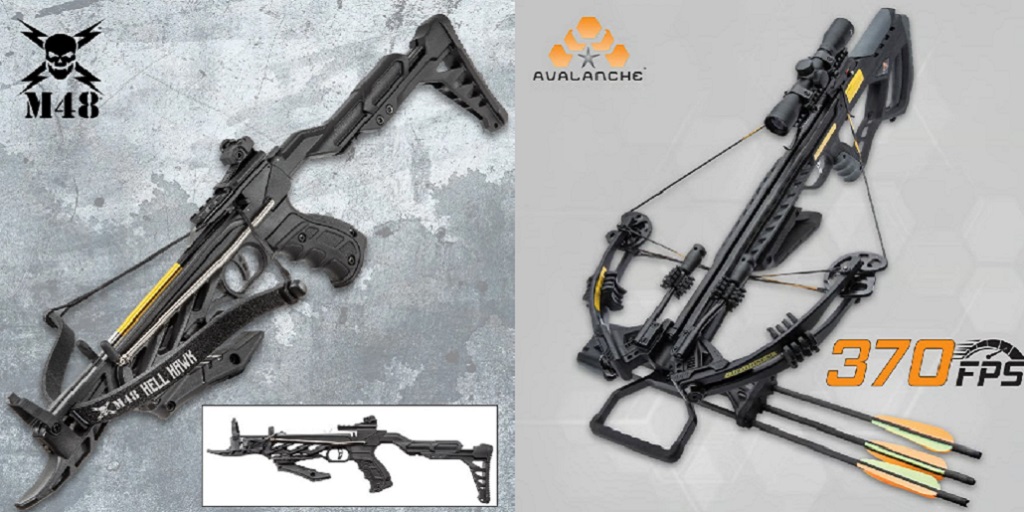
There is a much shorter learning curve associated with proficiency with crossbow tackle than there is with recurve bows and longbows, and of course, compound bows – vertical bows.
Crossbows shoot faster, hit harder, and most importantly, it’s much easier to become proficient and accurate with a good crossbow in a matter of hours, whereas it takes years to truly become adept with traditional archery tackle.
This makes them much more attractive not just for recreational shooting, but also for sporting pursuits, namely hunting, especially as more and more states adopt more liberal regulations for their archery seasons, many of which are now inclusive of crossbow tackle.
But there is one question that should still be asked. Just like in the world of conventional archery, there are simple recurve models as well as compound crossbows. We aim to answer a basic question – is one of these preferable to the other, and why?
Compound Crossbows
First let’s take a closer look at compound crossbows, as these are some of the most popular models in the industry, especially among hunters.
Unlike traditional recurve crossbows, in a compound model, usually, the limbs are split, and between the limbs there are cams that store energy and provide a mechanical advantage. The limbs are also joined by a set of two cables that help store and release energy.
However, unlike in a compound bow, with a crossbow there is no let-off. Rather, the main advantage of a compound model here is with respect to speed.
A compound model will shoot a crossbolt considerably faster than a recurve would, and speed equals power. Therefore, a compound model will produce more power while also shooting faster and flatter than a traditional alternative.
There are some drawbacks to this. One is that compound models tend to be a little more expensive than conventional recurve alternatives. Another is that they are harder to maintain and service.
Any old crossbow stringer can be used to string and unstring a recurve, but you need a bow or crossbow press to unstring the compound model, or to remove the cables. That said, let’s take a closer look at the relative virtues of some recurve models.
Recurve Crossbows
Unlike a compound model, a recurve crossbow is a much simpler system. They tend to be a little more affordable, but at the same time, they don’t shoot as fast as comparable compounds.
Even so, that is rarely a concern, as it is inadvisable to take long shots with archery tackle due to concerns that the target may “jump the string.” Even a compound doesn’t shoot fast enough to make a difference with that.
On top of that, the recurve crossbows are a little easier to care for. Stringing and unstringing is easy with a basic stringer, and you have only the one string to keep waxed, rather than a string and two cables.
In terms of maintenance and cost, a recurve is far more appealing to most shooters than a compound model. But to each his own; they both have selling points, and both can be highly effective not just for sport shooting but also for hunting and other sporting applications.
Affordable Crossbows: The Best of Both Worlds
Whether you think you’d be best served by a compound or a recurve crossbow, if you are looking for affordable options to get you into the world of crossbow shooting and hunting, the first place you should investigate is BudK.
They carry a wide range of recurve and compound crossbows along with bolts and a whole lot more. Take a look through their collection to find something that aligns not just with your needs but with your price point, and if you have any questions about specifications or would like recommendations, get in touch with them directly.
