
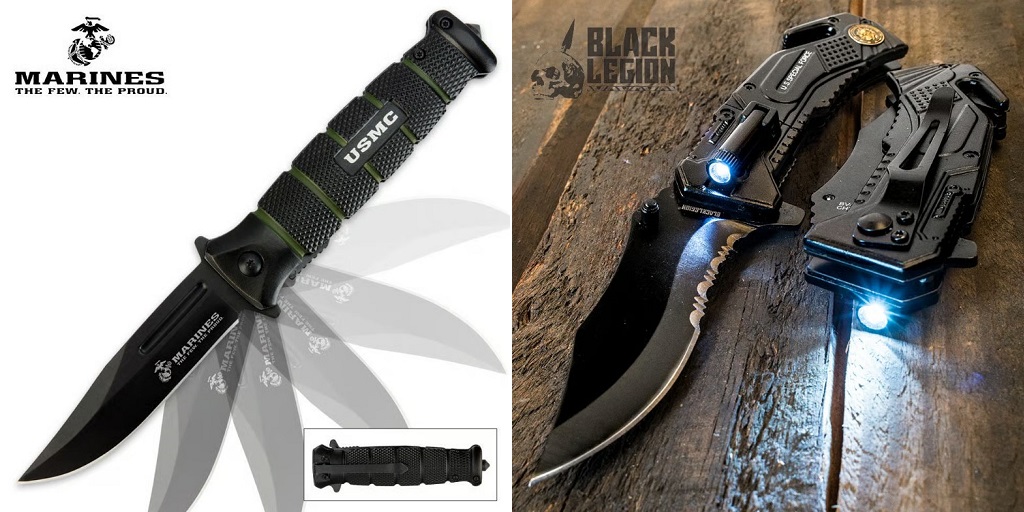
In the world of folding knives, there are three main types with respect to deployment: these are conventional (“regular”) folders, assisted opening knives and automatic knives, which are also known as autos.
But what are the relative differences between an assisted opening knife, an auto, and a “regular” knife? This post will break that down.
Conventional Folding Knives
Conventional, traditional folding pocket knives open via a nail nick and have no locking mechanism – like a Swiss Army Knife, for example.
However, most modern folding knives have features that make it easier to open the knife one handed. Common mechanisms or features including thumb studs, thumb holes, or flipper tabs – though there are others.
Most conventional folding knives with these features are designed to be opened with one hand, though there is a bit of a learning curve associated with that. That being the case, one who is proficient with those protocols can often open the knife very quickly.
Common folding knives also usually lock, either via a lockback, liner or frame lock, button lock or bar lock.
An Assisted Opening Knife
An assisted opening knife is effectively the same as a “regular” folding knife in all respects except one: there is an internal spring that provides an assist to open the blade.
Once the blade is opened partially, the spring will exert pressure on the blade, opening it the rest of the way with no further action from the person holding the knife.
Some users prefer an assisted opening knife simply because they are easier to use than conventional pocket knives. It is very easy to open an assisted opener with little effort and very little skill is involved. Basically you push a flipper tab and the knife does the rest.
In all other respects, an assisted opening knife is the same. They may have thumb studs, holes, or or a flipper tab, along with any of the lock types mentioned above.
Automatic Knives
Lastly we have automatic knives, which vary much more than the other two types of knives.
Automatic knives, or autos as they are commonly known, have an internal mechanism that is designed to deploy the blade. Often a flipper tab, a lever or a button is used to deploy the blade – most commonly a button.
There is no learning curve associated with deploying the blade of an auto and it is much easier than it is with a conventional knife or even an assisted opening knife. You just press the button and the blade deploys.
While you can also be pretty fast with an assisted opening knife, or even one that lacks such a mechanism, deploying an auto is invariably faster.
There are two main types of auto knives: OTS, or out the side, and OTF, or out the front knives, as well.
In an OTS configuration, not much would vary from a comparable conventional knife or even an assisted opener. The form factor and lock would be the same.
In an OTF knife, the blade comes out the front, and the knife would vary considerably in form factor, including the deployment method and the lock. An OTF knife usually will have two edges (but not always) and because the blade doesn’t need to swing out the side, this configuration can be better in cramped quarters.
Where to Learn More
Whether you’re here looking for a regular folding knife or are more interested in an auto or an assisted opening knife, bookmark BudK. Even if you don’t find what you’re looking for today, their catalog is always getting refreshed with unique new designs and products, many of which you won’t find anywhere else.
