Growing large tropical houseplants (monsteras, palms, fiddle-leaf figs, monstera, monstera adansonii, bird of paradise, etc.) indoors is a deeply rewarding endeavor, but it brings with it a set of unique challenges you don’t always encounter with smaller potted plants.
Among the most common issues are ensuring adequate light, managing heat, humidity, and airflow, dealing with cold or drafts, and handling pests or disease in a more controlled environment. This is where something like a 10×10 grow tent can be an excellent fallback (or even a proactive solution). Below, we walk through key considerations you should understand when growing large indoor plants, including our preferred indoor grow tent recommendation.
Key Challenges When Growing Large Houseplants Indoors
Before we talk explicitly about grow tents, let’s frame the problems you’ll typically face as your plants get big:
Light Intensity and Distribution
- Light requirement increases with size. A baby plant or a seedling might get by with modest light, but as leaves and canopy grow, the total photon demand goes up, both in terms of area and intensity.
- Spectral quality and light duration matter. Plants don’t just want visible light; they benefit from a fuller spectrum (including red, blue, and sometimes UV) and consistent photoperiods. Sunlight windows are limited to daylight hours and are subject to seasons.
Heat, Temperature Control & Thermal Stress
- Thermal fluctuations are damaging. If your day temperature climbs too high, or nights drop too low, plants can suffer stress, slowed growth, or outright dieback (especially tropical species).
- Radiant heat from grow lights or windows. If you try to supplement or replace natural light, the lighting fixtures themselves may heat up the surroundings. In a less controlled space, that heat can run away or lead to hot spots.
Humidity, Moisture, and Vapor Pressure Deficit (VPD)
- Tropicals often demand high humidity. Many large tropical species (palm, monstera, philodendron) are adapted to humid, stable forest understories. In a typical home, humidity can fluctuate widely (especially with HVAC on).
- Dry air stresses stomata and causes desiccation. If humidity is too low, the plant may lose more water than it can uptake, leading to browning leaf margins, curling, or slowed growth.
Because of all these interacting challenges, even a plant lover with moderate success in small pots can suddenly hit a “ceiling” when scaling up. That’s why, if you’re not sure your home has the right balance of light, temperature, humidity, airflow, and control, stepping into a more controlled indoor “room within a room” like a grow tent can be very advantageous.
Why a 10×10 Grow Tent Can Be a Great Solution
A grow tent is a self-contained environment in which you can control light, airflow, temperature, humidity, and other factors more tightly than in the ambient room. Among the many tent sizes, a 10×10 footprint gives you substantial room for medium-to-large plants while still being manageable in many homes (e.g. in a basement, spare room, garage bay, or converted corner).
Here are some of the benefits of using a grow tent setup:
● Controlled Light Environment
● Thermal and Humidity Isolation
● Air Circulation & Ventilation Integration
● Pest, Contamination & Light Leak Control
● Space Efficiency & Modularity
● Scalability & Future-Proofing
The Ideal Large Plant Growing Solution
If you’re in a position where you suspect your home may not provide stable, adequate lighting, humidity control, or temperature for very large tropical plants, a well-chosen grow tent is a tool to enable success.
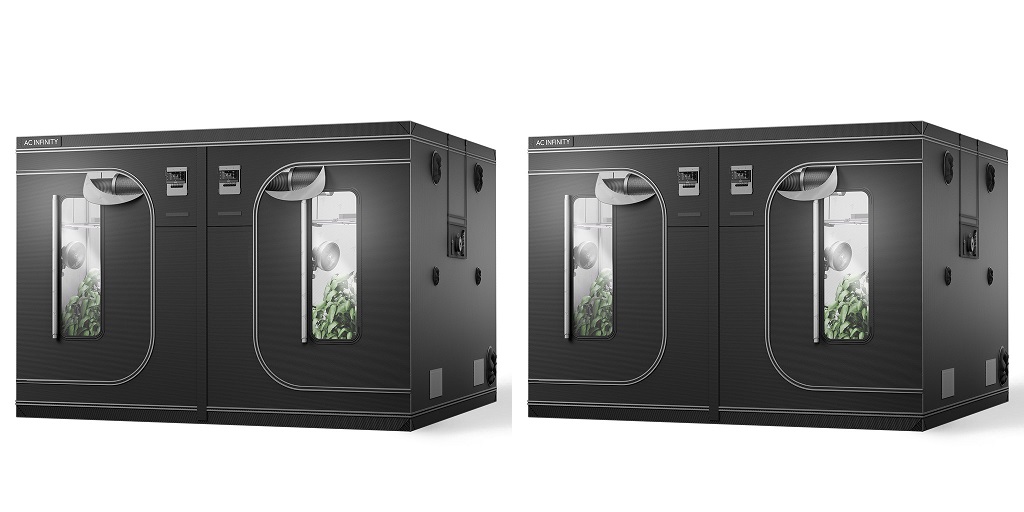
The CloudLab 10×10 Advance Grow Tent by AC Infinity offers a robust, professional-level framework to manage the principal challenges of indoor tropical plant growth. Its reinforced structure, high-reflectivity interior, multiple duct ports, and thoughtful design elements make it a serious candidate for someone wanting to scale up without compromising control.
That said, success still depends on how you set it up and maintain it. A tent doesn’t replace good horticulture practice; it gives you the environment in which those practices can be more reliably applied!