
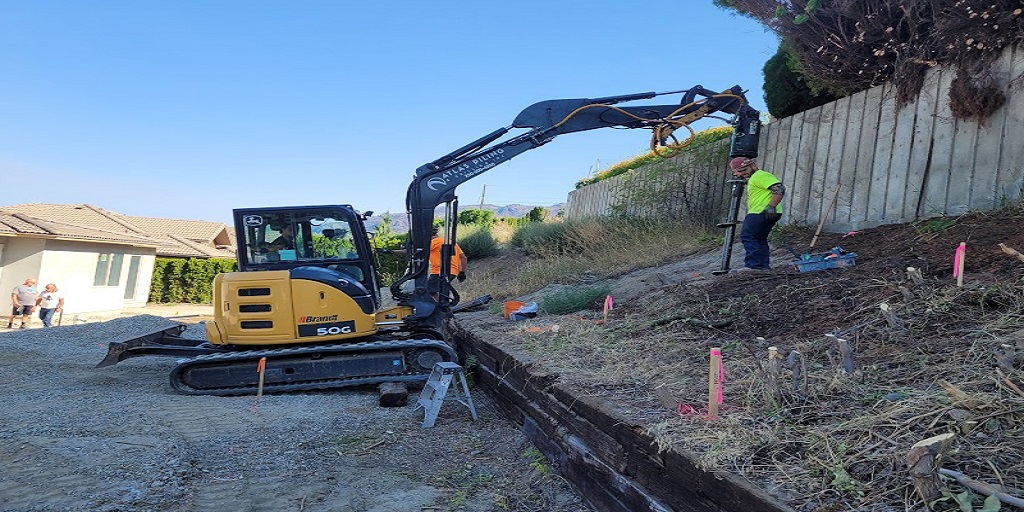
Helical pile foundations are renowned for their robustness and reliability, particularly in challenging soil conditions. Their effectiveness is largely attributed to the interplay between several critical factors: compression, tension, load, and torque.
Compression and Helical Pile Foundations
Compression refers to the force exerted on a helical pile as it bears weight from the structure above. In a helical pile foundation, this force is crucial because it determines how well the pile can support vertical loads. The helical plates, or “screws,” are designed to transfer compressive forces to the surrounding soil, which provides resistance against the load. The deeper the pile is installed, the more load it can support due to increased soil interaction and resistance. The design of the helical plates is specifically engineered to maximize the pile’s capacity to handle compressive forces, making it ideal for various structural applications.
Tension Forces in Helical Pile Foundations
Tension forces act in the opposite direction of compression, pulling the pile away from the soil. Helical piles are designed to handle these forces effectively through their unique screw-like design, which helps anchor the pile securely into the ground. When a structure exerts a pull or uplift force, the helical plates resist this tension by distributing the load over a larger area of soil. This resistance is crucial for maintaining the stability of the foundation, especially in areas prone to uplift forces such as high winds or seismic activities.
Load Distribution and Helical Pile Performance
Load distribution is a key factor in the performance of a helical pile foundation. The ability of a helical pile to evenly distribute loads across its length and into the soil significantly impacts its effectiveness. Proper load distribution helps prevent excessive settlement or tilting of the structure. The design of helical piles ensures that loads are spread uniformly, minimizing the risk of localized failure. This is particularly important for maintaining the integrity of the foundation over time and ensuring the longevity of the structure it supports.
The Role of Torque in Helical Pile Installation
Torque is the rotational force applied during the installation of a helical pile. It plays a crucial role in determining how well the pile is embedded in the soil. As the pile is screwed into the ground, torque measurements help assess the pile’s resistance to penetration and the overall quality of installation. Adequate torque indicates that the helical pile has achieved proper depth and soil engagement, which is essential for its performance. The torque also influences the pile’s load-bearing capacity, with higher torque generally correlating with greater stability and strength.
Common Applications for Helical Pile Foundations
Helical pile foundations are widely used in various construction scenarios due to their adaptability and strength. They are commonly employed for underpinning existing structures that are experiencing foundation issues, providing a stable base where traditional methods may not be feasible. Additionally, they are ideal for new constructions on challenging soil conditions, such as weak or variable soils, where their ability to handle both compression and tension forces is beneficial. Helical piles are also frequently used in areas with restricted access due to their minimal excavation requirements, making them suitable for urban and sensitive sites. Their versatility ensures reliable support across diverse construction needs.
The interaction of compression, tension, load distribution, and torque is fundamental to the performance of helical pile foundations. Each of these factors contributes to the overall strength and stability of the foundation, ensuring that it can withstand various forces and conditions. Understanding how these elements work together helps in selecting the right foundation system for different applications, providing lasting support for structures and contributing to their overall safety and durability.
