
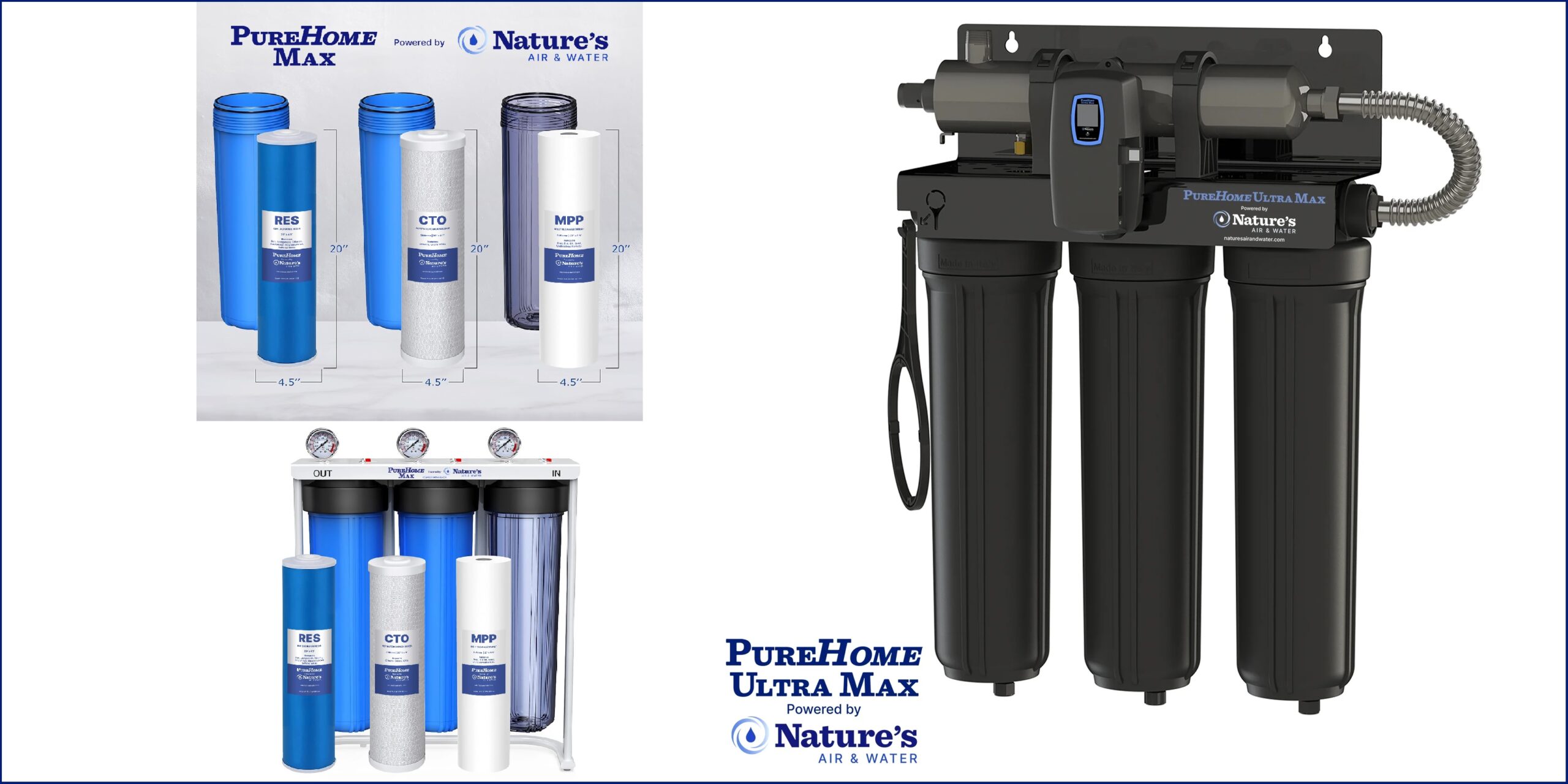
For those of you considering investing in a whole house water filtration system for your home, it’s important to recognize that there are many different types of filtration systems. They work in different ways, and each is capable of removing specific impurities and contaminants, some of which others are not.
This is why it is so important to know what types of technology a home water filter system uses; it is also important to note, however, that many whole home filtration systems use more than one type.
Here are some of the main technologies involved in water filtration, how they work, and what they can remove.
Activated Charcoal Filtration
Activated charcoal filtration uses activated carbon or charcoal, which is an extremely porous material with a massive surface area that is highly effective at absorbing (and adsorbing) chemical contaminants.
As water passes over the charcoal filter medium, the charcoal either physically absorbs or chemically adsorbs contaminants that come into contact with it. Charcoal filtration can be effective at removing contaminants like chlorine and other chemicals, improving the taste, smell and clarity of the water. To a certain degree, charcoal filtration media can also remove some particulate matter from a water supply.
Mechanical Filtration
Mechanical filtration relies on physical means to remove contaminants from water by passing pressurized water over a porous filter medium. It is the most effective way to remove sediment, sand, bits of rust, and other small particles from the water stream. Since microbes can cling to sediment, it can also reduce the biological contaminant level.
Some mechanical filters have very small pore sizes of only a few microns in diameter, making it possible for them to remove some biological contaminants as well.
Reverse Osmosis Filtration
Reverse osmosis requires the passage of water over a semi-permeable membrane. The membrane acts like a very fine sieve, and allows only water to pass through, trapping other contaminants, including minerals, heavy metals and other chemicals, sediment and biological contaminants, like bacteria and protozoans, on one side.
Reverse osmosis is one of the most effective means of water filtration, effectively removing all physical, biological and chemical contaminants from a water supply.
Ion Exchange Filtration
Ion exchange filtration relies on the use of electrically charged media to sequester and remove ions (charged particles) from the water supply. Chiefly, this means of filtration is intended to remove dissolved heavy metals as well as the minerals that cause scale (magnesium and calcium) from a water supply.
Ion exchange filtration is effective at removing these contaminants, but because it does not physically filter the water, it can allow biological contaminants, sediment, and other dissolved chemicals to pass through.
UV Water Filtration (Purification)
We also have UV water purification, which is sometimes referred to as UV water filtration despite the fact that it does not actually physically filter the water.
Rather, UV water purifiers sterilize water supplies by irradiating them with UVC radiation, which can be effective at killing up to 99.99% of biological contaminants, including bacteria, mold, viruses, and protozoans, all of which can cause illness in humans.
Where to Learn More About Home Water Filtration Systems
As stated, many whole home water filtration systems combine more than one of these types of filtration technologies to be more effective.
If you’re interested in learning more about the different types of whole home water filtration systems out there, visit Nature’s Air and Water. They carry many different options which combine some of the different types of filtration mentioned in this article.
For more information about Kitchen Sink Water Filter and Water Filter Straw Please visit: Nature’s Air and Water, LLC.
