
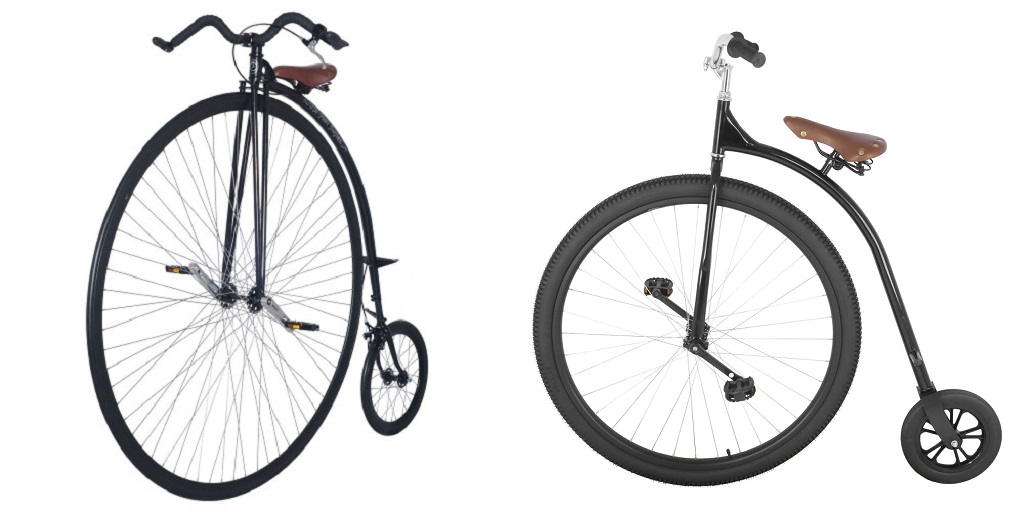
The surviving images of suit-clad, mustachioed gentlemen riding penny farthings might have left you with the impression that these bikes were the things of entertainment. Perhaps for their riders, yes, but not necessarily for spectators. Unlike modern clown circus bikes, penny farthings (in their day) were cutting-edge technology, and ridden for sport, not chicanery.
With that out of the way, penny farthings were among the fastest machines in the day – a skilled rider could outpace a horse – meaning unlike clown circus bikes, they’re built for speed.
It also happens that penny farthings were remarkably dangerous, or at least they could be, if the person riding them was not conscientious of basic physics and some essential safety maxims.
The thing about penny farthings is that they are not only fast, but their nature requires the rider to sit high over the obnoxiously large front wheel. This creates a high center of gravity from which it is very easy to fall.
When you’re riding a penny farthing, if you slam on the brakes or if some impediment that the wheel can’t cross, there’s a high likelihood that you’re going to experience an unfortunate occurrence called “taking a header.”
Bluntly, this refers to a rider being thrown headlong over the handlebars. At speed, it can be quite deadly.
When riding a penny farthing, there are things you can do to prevent this. An important one is not to ride too fast while you are learning. Be conscious of the machine and take it slow as you go.
The other is learning how to read the road. When you’re learning, keep things simple and stick to paved or otherwise smooth surfaces. Bumps won’t cause you to take a dreaded header, but obstructions in the road or trail certainly can.
Now this last suggestion is easily the most important. You need to give yourself time to come to a stop, as well as to learn how to gently brake the penny farthing.
Distance is key here, as whether or not you are proficient at using the brakes, you need to slow the thing down quickly. A penny farthing bike cannot come to an abrupt stop or you will go over the handlebars, taking a header, whether you applied the brakes or not.
Now that that’s out of the way, there are two good ways to slow down a penny at a metered pace. One is with the pedals. When you’re ready to start slowing down, simply apply backpressure as the pedals rotate; this will help slow down the front wheel.
The other is to use the brake itself. Step off of the pedals and onto the pegs over the rear wheel. This will place pressure on the small tire that has the brake connected to it; then apply the brakes, but do so gently. This should help you coast to a stop.
It is important never to aggressively apply the brakes, not only because this increases the likelihood that you’ll take a header, but because if you hit the brakes hard while the bike is moving fast, all that you’ll accomplish is making the rear wheel skid.
That can cause flat spots and wear out your rear tire faster, so just don’t do it.
Looking for a New Penny Farthing or Clown Circus Bike?
Have you stumbled upon this article because you’re looking for penny farthing resources or parts or are in the market for a new clown circus bike? Either way, get it online at Unicycle.com. They carry a wide range of odd bikes (including penny farthings and circus bikes) along with tools, parts, and a wealth of educational materials.
