
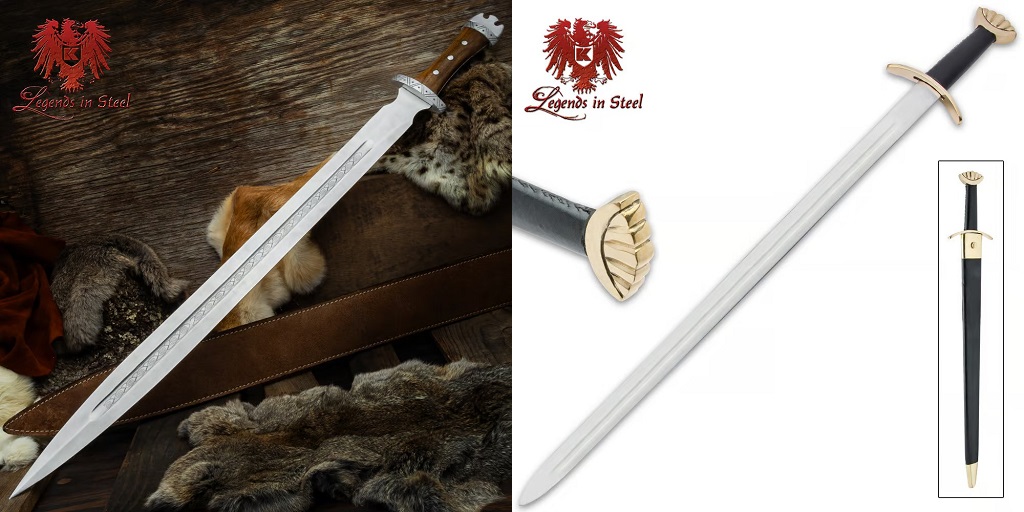
Viking swords, also known as Carolingian swords after the fact that many of them were made in France during the Carolingian Era, are iconic staples of the culture of Northern Europe. In the minds of many, a Viking just wouldn’t be a VIking if it weren’t for his (or her) sword – or, to some, for his ax.
With that said, many, perhaps most, even, would not be able to identify the typical “Viking sword.” This short post should help with that.
The Hilt
The main identifier of a Viking sword is going to be the hilt, hands down.
First things first, the majority of Viking swords, and certainly the typical patterns, were one-handed swords. The grip of the hilt was narrow to the point that it could only accommodate one hand and was conventionally made with wood or wrapped with leather.
The crossguard, also known as the quillion, would be either short and straight or lozenge shaped, or with a slight radius, and curving forward. The crossguard might have been plain, but it would also likely have been ornamented with precious metal filigree or inlaid with bone or jewels.
The pommel is another of the unique identifiers of the classical Viking sword. They were usually made with three to five lobes in the shape of nuts, though the pommel might also have had a single, horizontal lobe.
Like the crossguard, the pommel would likely have been very ornately decorated with precious metal work, bone, or gems. It might also have been inscribed with a bearer’s or maker’s name, or with a runic inscription.
The Blade
As single-handed weapons, the blades of most Viking swords would have been relatively short, usually between 20” to just less than 30”, though there could have been exceptions on either end.
The conventional Viking sword would have had a double-edged blade with a wide fuller – also known as a blood groove, which was added to the design of the blade both to lighten and strengthen it.
While the hilts of many Carolingian swords would have been very floridly decorated, most of their blades would have been fairly plain. If they were decorated at all, it would have been with the mark of a maker, or perhaps with a runic inscription, which was not particularly uncommon in Northern Europe.
The Scabbard
The scabbards associated with Viking swords would have been the least immediately identifiable of all the sword’s components.
Conventionally, they would have been made of a combination of wood and leather, and so few of these scabbards have survived. However, it would have likely been customary to create a scabbard with a steel, brass or bronze chape and throat, which would have helped secure the blade and prevented damage to the scabbard.
The chape was a component at the base of the scabbard near the sword’s point; making this from a metal would have helped prevent the point from damaging the end of the scabbard. On the other end, the throat, with its “locket” would also have likely been made from some alloy so as to better secure the sword in the scabbard.
Other than that, most of the notes for identifying Viking pattern swords would be specific to the hilt and blade rather than the scabbard.
Where to Get a Real, Battle-Ready Viking Sword Replica
Interested in getting a real, battle-ready sword for your collection – and do you want it to be patterned after a classical Viking sword from Northern Europe? Make the first place you check True Swords. They carry a wide range of sword replicas, and many of them are made to such a high standard of quality that they can withstand the rigors of live training. Visit their website for more details or get in touch with them directly.
For more information about Japanese Sword and Ninja Sword Please visit: True Swords.
