
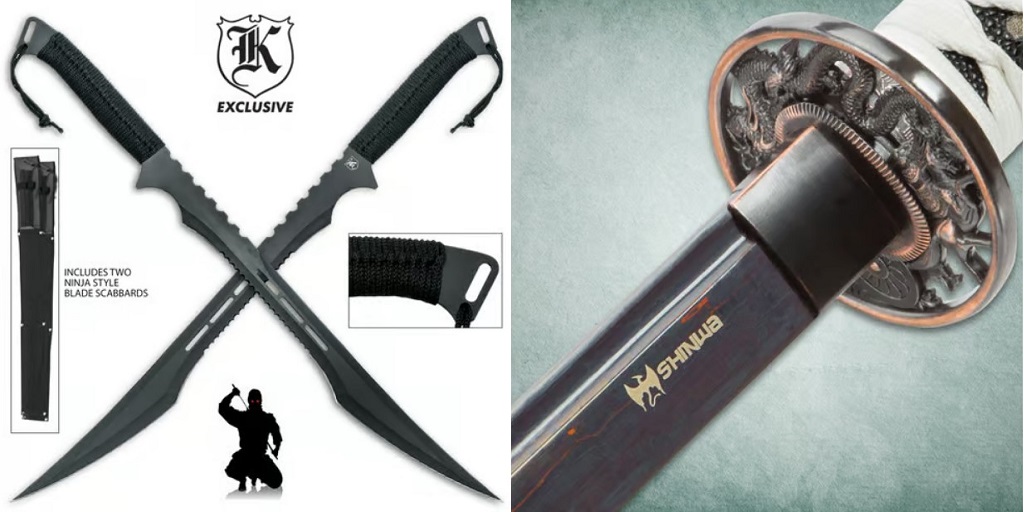
The iconic weapons of the samurai and ninja have long fascinated enthusiasts of Japanese culture. Though often lumped together as variations of the katana, samurai swords and ninja swords are fundamentally different in design, purpose, and historical significance.
These distinctions reflect the unique roles that samurai and ninja played in Japanese society and the ways their weaponry catered to their respective missions.
Design and Structure
Samurai katanas are masterpieces of craftsmanship, designed for both utility and artistic expression. They typically feature a curved blade, which facilitates powerful and effective slashing motions.
This curve is not only aesthetically striking but also functional, as it creates a natural arc during a strike, enhancing the blade’s ability to cut. Samurai katanas are longer than ninja swords, with an average length of about 70 centimeters.
They also have intricate details on the tsuba (hand guard) and saya (scabbard), often adorned with ornate designs and materials to reflect their owner’s social status and honor.
In contrast, ninja swords are more utilitarian in design. Often depicted as straight-bladed and shorter—approximately 40 centimeters—these swords prioritize practicality over elegance. Their simplicity makes them easier to wield in confined spaces or environments where stealth is key.
The straight blade is ideal for stabbing, which aligns with the ninja’s need for quick, decisive actions in close quarters. The tsuba of a ninja sword is typically larger than that of a samurai katana, serving practical purposes such as acting as a foothold when the sword is used as a step to climb walls. The saya is usually matte black, designed to avoid reflecting light and revealing the ninja’s position.
Symbolism and Usage
Samurai katanas are steeped in spiritual and cultural significance. Known as the “soul of the samurai,” these swords were more than mere weapons; they symbolized the samurai’s honor, duty, and connection to the divine.
This reverence extended to their craftsmanship, with each katana meticulously forged and regarded as a sacred object. Samurai often carried two swords: a katana and a shorter wakizashi, signifying their elevated social status and right to bear arms.
Despite their iconic image, samurai primarily relied on other weapons, such as spears and bows, in large-scale battles. Katanas were reserved for close combat or ceremonial use, which explains why many historical katanas remain in pristine condition today.
Ninja swords, on the other hand, were tools of practicality rather than symbols of honor. As covert operatives, ninjas used their weapons to accomplish specific missions, often involving espionage, sabotage, or assassination.
A ninja sword was a multipurpose instrument: it could serve as a step ladder, a snorkel, or even a container for small accessories like medicine. These adaptations highlight the ninja’s resourcefulness and focus on functionality.
Unlike samurai, who carried their swords as badges of their status, ninjas prioritized concealment and practicality, reflecting their role as shadowy agents rather than warriors bound by a strict code of honor.
The Ninja Sword’s Historicity
While samurai katanas have a well-documented history, the existence of dedicated ninja swords is a subject of debate. Some historians argue that the “ninja-to,” the straight-bladed sword associated with ninjas in popular culture, is largely a product of modern imagination.
Most historical accounts suggest that ninjas likely used modified samurai swords or other improvised weapons. The so-called ninja swords displayed in museums or sold as replicas were often created during the Meiji era (1868–1912) as part of Japan’s burgeoning tourism industry.
These replicas catered to Western fascination with ninjas and may not accurately represent historical reality. And despite this skepticism, the idea of the ninja sword persists, fueled by its frequent portrayal in manga, anime, and films. Now, these blades have a larger than life reputation, and are sought after by collectors, even if the lines between ninja sword and samurai sword are blurred.
True Swords has the best collection of ninja swords and other historical blades online. Visit them today if you are interested in this intriguing niche of pop culture and history.
