
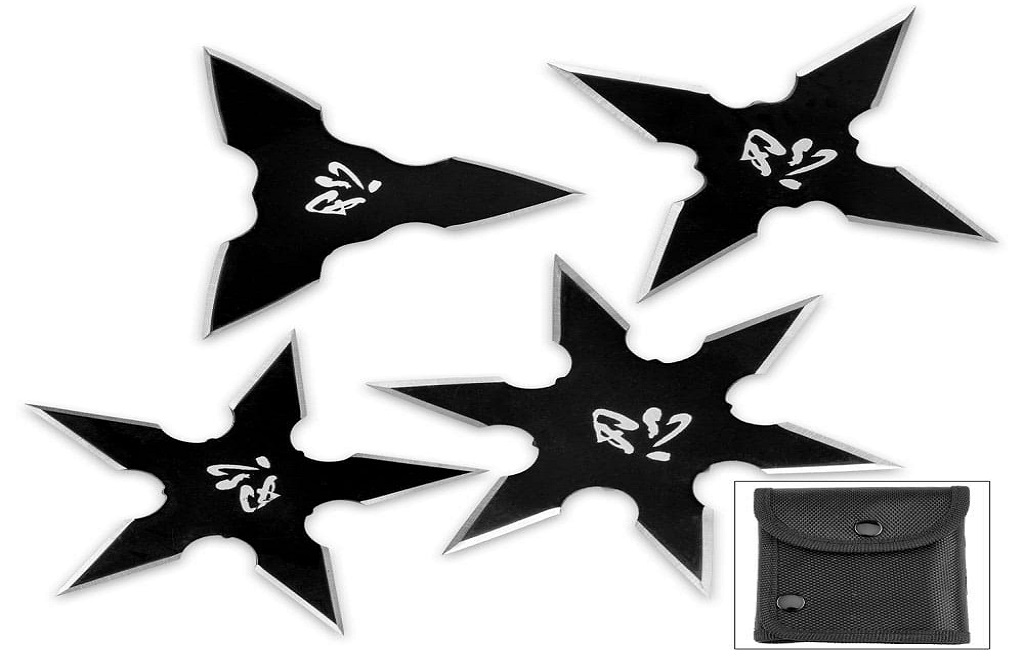
Ninja stars constitute a curious class of throwing knives that, unlike conventional throwers, tend to have several blades or points. This makes it much easier for someone to learn to throw them, and shortens the learning curve.
There’s also a relatively strong market for them in the United States, so we rounded up some of the most common questions surrounding them and answered them here.
Do Ninja Stars Have Another Name?
Ninja stars, which you may also hear referred to as throwing stars, fall under a class of Japanese throwing weapons known as “shuriken.” They vary considerably in design, including in size and profile, as well as in the number of blades or points they have.
How Many Blades Does a Ninja Star Have?
While some throwing stars may have as few as two points – in which case they aren’t really “stars” – the majority of these throwing weapons have between 3 and 5 points – though some may have several more.
Do Ninja Stars Actually Work?
Yes, ninja stars actually work, though it can take a little bit of practice to get used to throwing them. Because they are mostly made with 3 or more points, and lack a pronounced hilt, they can be highly effective as throwing tools.
How Were Throwing Stars Historically Used?
Apparently, throwing stars, though they were carried historically, were not intended to be used as a lethal weapon, though they could potentially cause serious injury if they struck a vulnerable area. Rather, they were intended to produce a distraction to enable the thrower to escape or launch a more direct attack.
Are They Easier to Use Than Throwing Knives?
Most users would argue that much of the popularity behind ninja stars has directly to do with the fact that they are easier to learn to throw than most if not all throwing knives, and that the learning curve is much shorter.
Because of the number of points, it’s relatively easy to learn to throw a throwing star, and once you get the basic form down – along with the balance of the stars you’re throwing – it becomes a lot easier.
Does Steel Matter?
The steel does in fact matter, but as a general rule, throwing stars are made with softer steels, like 440 stainless steel. This helps prevent them from shattering or chipping when they’re thrown and strike a target. The stainless aspect of the alloy is also valuable because it streamlines maintenance.
Can You Buy Ninja Stars?
Though some states, like New York and California, have outlawed throwing stars (and they may be illegal in other jurisdictions, do your own legal research) ninja stars are legal to own in the United States.
If you want to learn more about throwing stars, check out BudK and start your search there. They carry a wide range of shuriken and other unique tools, weapons and collectibles, in addition to daggers, swords and functional knives. Check out what they offer and see if there’s something in there for your collection today.
For more information about Karambit Knife and Fixed Blade Knife Please visit: BudK Worldwide Inc.
