
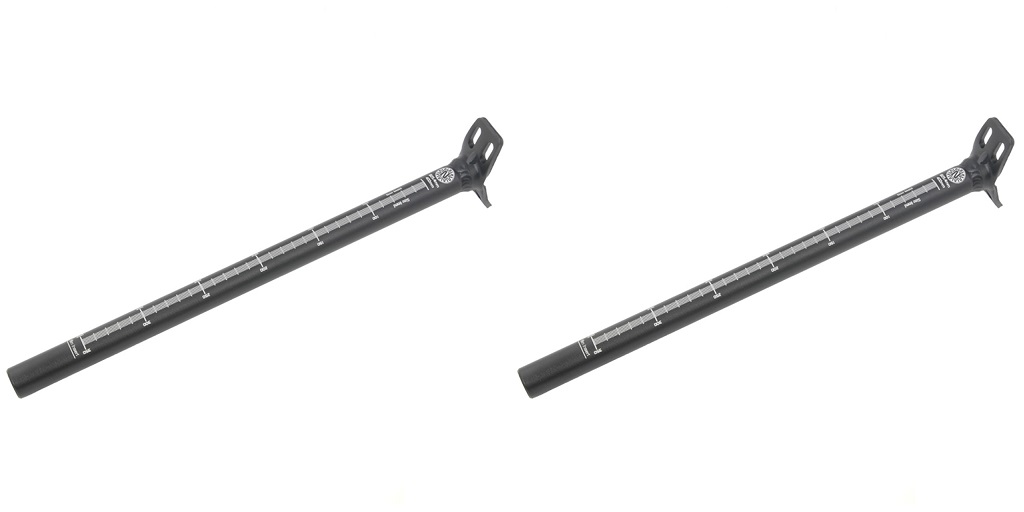
The size of a bike seatpost clamp matters because not all clamps will work with all frames or seatpost tubes, depending on your rig. But that is not a matter for this article.
This article will cover the two main types of bike seatpost clamp with respect to how they secure the seatpost tube and thereby the saddle height, enabling you to properly adjust the ride for your dimensions.
The Bolted Configuration
Some bike seatpost clamps tighten via the action of one or two bolts. In order to raise or lower the seatpost tube in the frame (and by extension, the saddle) you need to be able to manipulate these bolts.
The majority of bike seatpost clamps accept either a 4, 5 or 6mm Allen key – making this a vital tool for your bike pack, anyway.
Since your only limiter here is the torque you apply manually, you can really get a secure adjustment with this style of seatpost clamp. The catch is without the tool you’re dead in the water.
So, if for whatever reason you want to make an adjustment, say for comfort, on the fly, if you forgot your tool set at home, you’re out of luck.
That brings up an alternative configuration.
The Quick-Release Configuration
Some bike seatpost clamps have bolts, others have either one or two quick-release levers, or clamps, that allow you to adjust saddle height by shifting the tube up or down.
These are much easier to adjust in the field and are tool-free. So, for ease of use, the quick-release configuration has the edge over the bolted configuration.
The only potential caveat is that it might not offer the same security – but when adjusted properly, they’re basically just as strong as a bolt configuration. So there’s little to worry about there.
The Clamp’s Not Cutting It: What Else Can I Do?
For bike riders, this is the end of the story, since you can raise or lower the seat pretty much as high or low as you like because the tube is between the wheels, and there’s little in the way.
However, some bike seatpost clamps are also compatible with unicycles, and here we have a distinct issue.
With a unicycle, the seatpost tube sits right above the wheel, and you’re limited in how low you can set it because you can’t ride with the tube obstructing the tire.
Therefore, it sometimes becomes necessary to cut down a seatpost tube to get a good fit for your dimensions. That has been covered elsewhere; see Unicycle.com’s “Assembly FAQs” for more information.
Where Can You Get a New Bike Seatpost Clamp?
Here because you need a new bike seatpost clamp for your bike or unicycle? Check out Unicycle.com. In addition to seatpost clamps, they also carry safety gear, pedals, rims, tires, and tools that can be used on both one and two-wheelers, so to speak.
And, if you have any questions, contact them for more information, their customer service team would be more than happy to help.
