
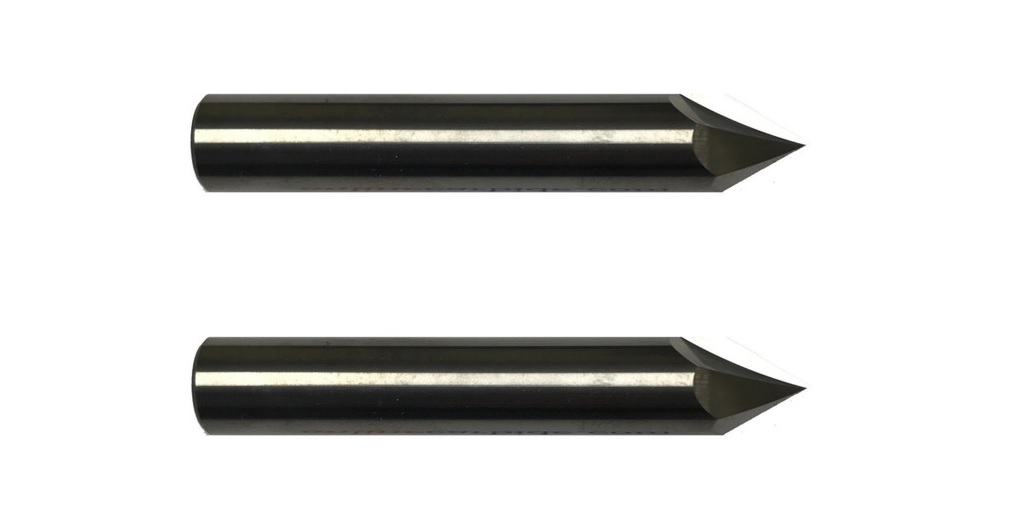
Machinists use a lot of specialized cutting tools with different, equally specialized coatings. Depending on the mill, the coating, the workpiece and the type of operation, a mill can (or can’t) perform a wide range of different functions.
One of these types of mills is called a chamfer end mill. Here’s what you should know from a high level.
What Is a Chamfer End Mill?
A chamfer mill, which is also known as a chamfer cutter, is a very versatile type of end mill that can be used for a wide range of applications which will be described in the next section.
Chamfer mills are characterized by a straight, untapered shank and a chamfered angle that usually ranges from 60° to 120°, although shallower angles are available. Because of their versatility, they are some of the most common mills in the machinists toolkit.
When selecting a chamfer end mill, some of the most common considerations that the machinist must take into account are the chamfer angle, the max chamfer depth, the material of the workpiece (and speed of operation) as well as whether the mill will be used for front or back chamfering.
How Are Chamfer Mills Used?
Chamfer mills can obviously be used for chamfering, hence the name. This is the process of cutting an angle into a portion of the edge of a workpiece – but not the entire edge, which creates three faces. They can also be used for beveling, in which case the chamfer mill is used to remove a sharp angle from the edge of a workpiece, creating a slope from one face down to the opposing side.
In addition to chamfering, chamfer end mills are also used for:
- Deburring: Oftentimes, a rough edge is left on a workpiece with multiple jagged metal “burrs” that are for any number of reasons undesirable. A chamfer mill can be run along the edge of the workpiece to remove these aberrations, leaving a smooth, finished edge.
- Spotting: Drilling holes through a workpiece is rarely a one step process. Oftentimes, chamfer mills are used for “spotting” the process of cutting a small spot or dimple into a workpiece that serves as a “pilot” depression for the subsequent drill or mill. The practice of spotting with a chamfer mill helps prevent drill deflection and walking, which can damage both the tool and workpiece.
- Countersinking: Countersinking is the process of creating a wider hole in instances in which a threaded fastener will be used. This enables the head of the screw to sit flush with the finish surface of the workpiece, creating a cleaner, smoother surface.
Where Can You Find Quality Chamfer End Mills Online
Looking for high-quality chamfer end mills for sale online? Check out Online Carbide. They sell a wide range of solid carbide drills and end mills, including chamfer mills, at competitive prices – and their tools are proudly made in the United States.
For more information visit their website or get in touch with them directly at 630-238-1424.
