
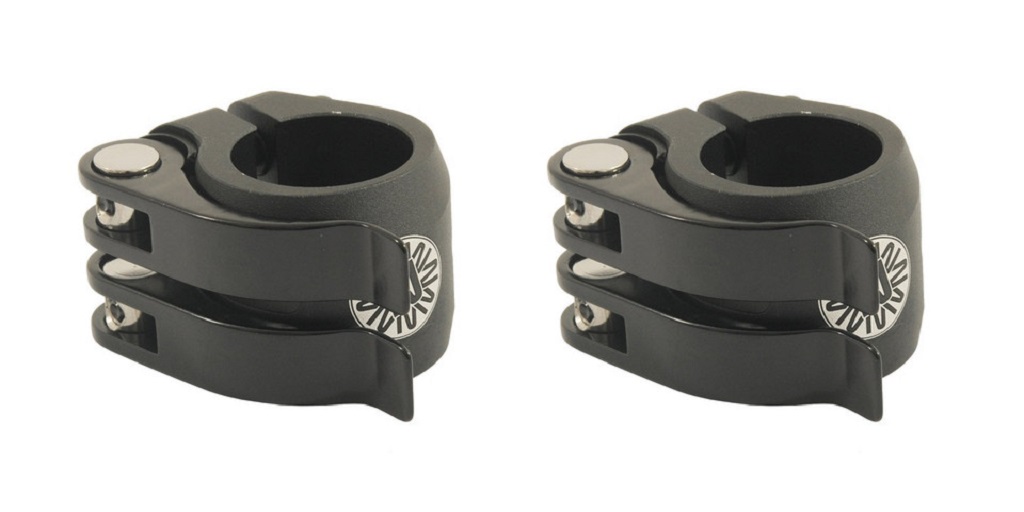
One of the most innocuous parts of a bike or unicycle, the seatpost clamp is, nonetheless, a critical piece of hardware for a most important reason.
It is the part you need to loosen in order to adjust the seatpost up or down within the frame, and therefore, is essential to adjusting saddle height.
Now, another word on this: saddle height isn’t just about comfort while you’re riding. It is about safety and energy expenditure.
If the saddle is either too high or too low, you will experience greater fatigue, earlier on, and worse, it shifts your center of gravity from where it should ideally be, which can be a safety concern.
So let’s take a quick look at the two main configurations of seatpost clamps out there.
Bolted Seatpost Clamps
First, we have bolted seatpost clamps, which can be either single bolted or double bolted.
Both single and double bolt seatpost clamps tighten around the seatpost tube via the action of hex bolts. A single bolt model is easier and quicker to adjust, but a double bolt version will hold the tube more firmly.
Either way, you can apply a lot more pressure with a bolted seatpost clamp than you can with a quick-release clamp (which will be explored more below).
The tradeoff is that to adjust saddle height in the field, you need to have an appropriately sized Allen key with you – which is definitely not very convenient.
All the same, a unicycle or bike tool like one of these only costs a few dollars and is small and light enough to easily add to a pack.
Quick-Release Seatpost Clamps
On the other end of the spectrum, we have quick-release seatpost clamps. Like bolted clamps, they perform basically the same function but they work according to different principles.
In place of a bolt, there is either a single or a double clamp operated via the action of a lever. Opening it loosens the hold the clamp has on the seatpost tube, and clamping it shut locks the tube in place.
The nature of operating one of these types of seatpost clamps should cue you into the fact that they’re really not as secure as, nor can they be tightened quite like bolted clamps. Nonetheless, for most intents and purposes, they work just fine.
There is another reason these seatpost clamps are desirable for some riders. To adjust one, you don’t need any tools.
So, if for any reason you want to adjust your saddle height when you’re out there or on a trail, just hop off the saddle, loosen the clamp, adjust, then close the clamp, and you’re good to go.
Therefore, with a quick-release style seatpost clamp you get convenience and ease of use at a slight tradeoff with respect to how much you can tighten the clamp on the tube.
All in all, it just comes down to what matters most to you. Both are excellent styles of clamps and each has its own use cases.
Here to Get Seatpost Clamps?
Looking for a new seatpost clamp for your bike or unicycle? Need a new bike tool so you can make adjustments to your saddle height via the clamp?
The place to get either of these things, and other riding essentials, is Unicycle.com. Check out their website, at which you’ll find a wide range of tools, unicycle parts (including seatpost clamps) and safety gear, among other cool finds. Before buying, however, remember that you need a clamp of appropriate size for your bike or unicycle to ensure compatibility.
Visit their website or get in touch with them directly if you have any questions about specifics.
