
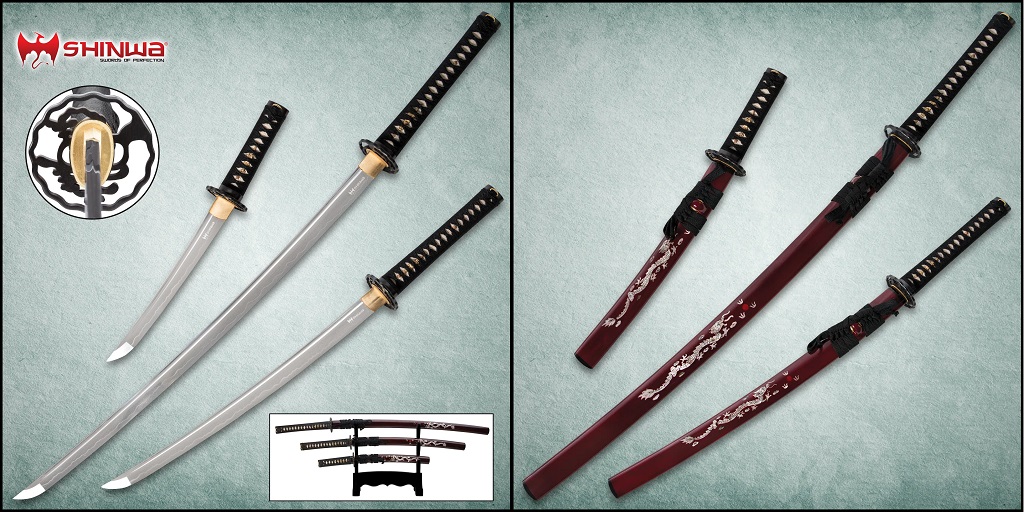
Have you ever wondered how ancient swords would match up to their modern counterparts?
A real samurai sword carries a mix of history, artistry, and engineering that modern replicas rarely match. When collectors talk about an authentic Japanese sword, they are referring to blades shaped by centuries of experimentation, battlefield experience, and strict craftsmanship.
These swords were not created as decorative pieces. They were tools for survival, status symbols, and in some eras, sacred objects. Understanding what sets them apart helps collectors recognize which modern versions come closest to the genuine blade.
The Swords in Japanese History
The earliest blades in Japan were straight. Later designs introduced curves, which became a defining feature of the swords associated with samurai culture. That curve was not added for style. It was a byproduct of the technique that strengthened the blade.
Swordsmiths used a method that hardened the edge while leaving the spine more flexible. When the steel cooled, it naturally bent. Over time, smiths learned how to control that bend and adjust the curve to suit different fighting needs.
A real samurai sword was never considered one single type. Japan saw a progression of designs shaped by warfare, horseback combat, foot soldiers, and even political stability. Long curved blades meant for mounted warriors existed alongside shorter blades used inside buildings.
These swords were carried differently, and even handled differently, resulting in different qualities and designs. Later, others were worn tucked into a sash with the edge facing upward. These differences matter because each sword reflects the purpose it was built for.
The Warrior’s Blade
The katana in its classic form developed when smiths focused on a length that balanced speed, handling, and cutting strength. It was not a primary battlefield weapon. A samurai relied more on bows or polearms and reached for the sword only when things fell apart.
Even so, the katana became the cultural symbol of the warrior, especially when paired with its shorter companion, the wakizashi. That pair became a badge of class in the centuries of peace that followed.
For any collector looking for a real samurai sword that carries the qualities of their historic counterparts, the following are the most important qualities to look for:
- One is the hamon, the visible line created by the differential hardening process. On true historical blades, this line is not decorative. It is a signature of the forging method.
- Another is the shape of the tang. Old tangs were never polished clean. Rust on a tang is not decay; it is evidence that the sword was not altered or refinished.
- The grain of the steel, known as the hada, also tells collectors about the skill of the smith and the region where the blade was made.
Many modern swords try to imitate these features, but few succeed. Stainless steel versions sold online are not close to the real thing. They are often brittle, overly shiny, and made for display.
Collectors looking for a sword that resembles what samurai actually carried should look for traditional steel, a natural hamon, proper weight, and a tang made in the old style. They should be wary of swords that appear too perfect or too symmetrical. Real swords had personality, and their differences came from the hand that made them, not from a machine.
A real samurai sword is a combination of history and craft. Modern blades that honor those methods come closest to the originals, and for collectors, those are the ones worth seeking out.
For More Information About Realistic Katana and Samurai Sword Cane Please Visit: True Swords.
