
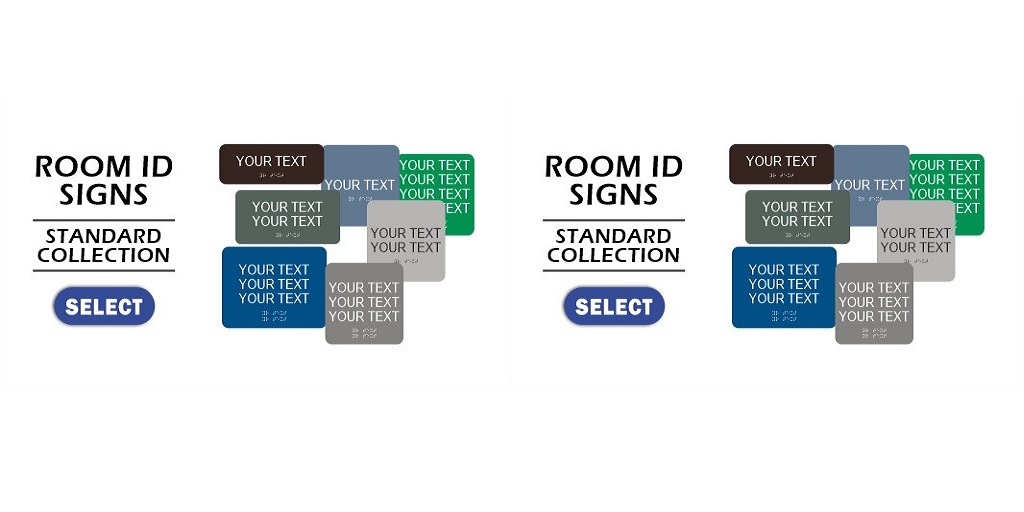
Everyone wants accessibility, mobility, and safety when moving around, and that includes anyone who might have an issue with mobility. Room ID signs make buildings accessible, safe, and easy to move through for everyone, and under the Americans with Disabilities Act (ADA), these signs must meet specific standards for accessibility.
What the ADA Requires for Public and Commercial Spaces
The ADA sets standards to ensure that people with disabilities can move through public and commercial spaces independently. Without clear identification of rooms, individuals with visual impairments, cognitive disabilities, or mobility challenges may struggle to locate essential spaces like restrooms, offices, or exits. These signs are not just a legal requirement. They are a practical way to make environments more inclusive and functional for everyone.
At the core of ADA requirements is the idea of equal access. People who are blind or have low vision rely on tactile information rather than visual cues. That is why compliant room identification signs must include raised characters and Braille.
The raised text allows users to feel the letters, while Braille provides a standardized reading system for those who use it. This combination ensures that important information is available in multiple formats, not just printed text.
Strict Design Guidelines for Room ID Signs
ADA-compliant signs also have strict design guidelines. For example, the text must be easy to read, using simple fonts and a minimum height for characters. The letters and numbers are typically raised slightly above the surface, making them detectable by touch.
Braille dots must be placed at a consistent height and spacing so they can be read accurately. In addition, the sign’s surface should not be shiny or reflective. A matte finish helps reduce glare, which improves readability for people with limited vision.
Contrast is another key factor. The color of the text must stand out clearly from the background. High contrast makes it easier for people with visual impairments to distinguish the information quickly. For instance, dark text on a light background or vice versa is commonly used. While design flexibility is allowed, readability always takes priority over decoration.
Placement is just as important as design. ADA guidelines specify where room identification signs should be installed so they are easy to locate. Typically, they are mounted beside the door, not directly on it, because doors can be open or closed.
The height must also fall within a specific range so that someone standing or using a wheelchair can reach and read the sign comfortably. Consistency in placement helps users know exactly where to look in any building.
Public Spaces, Situations, and People
There are many situations where these signs are required. Any permanent room or space that serves a specific function must be identified. This includes restrooms, offices, classrooms, hotel rooms, conference rooms, and storage areas that staff or the public may need to access.
Temporary spaces or areas that change frequently, like event rooms with rotating schedules, may not always require permanent tactile signs. However, most fixed locations in public buildings do.
Also, the benefits of installing compliant signage go beyond legal compliance. People with visual impairments are the most obvious group who benefit, but they are not the only ones. Visitors unfamiliar with a building rely on clear signage to find their way.
Older adults with declining vision also benefit from high-contrast, easy-to-read text. Even people without disabilities appreciate clear labeling, especially in large or complex spaces like hospitals, schools, and office buildings.
Meet ADA Guidelines with Braille Sign Pros
ADA requirements for signage are about more than rules and measurements, and Braille Sign Pros know this. They are about making spaces usable for everyone, so building owners and organizations can create environments that are safer, and easier to maneuver through. Braille Sign Pros make compliant room ID signs that are a simple but powerful tool for accessibility and inclusion.
For more information about Braille Room Number Signs and Braille Elevator Signs Please visit: Braille Sign Pros LLC.
