
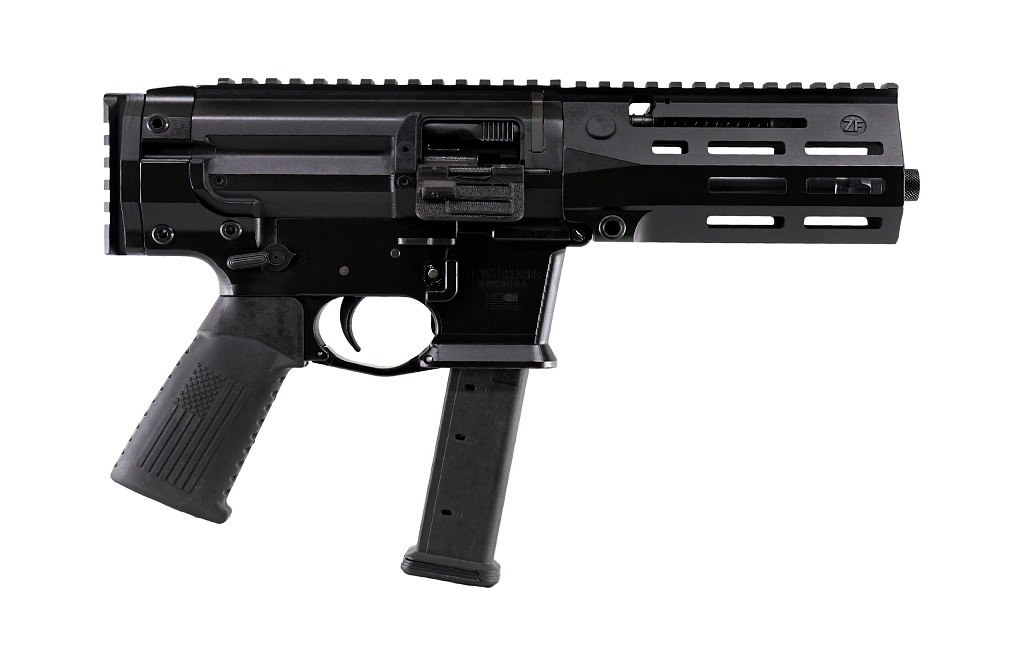
The vast majority of AR style rifles, including AR pistols, or ARPs, are actuated by an operation known as direct gas impingement. Some, such as the MRDS platform used by Zenith Firearms in models like the ZF-56 and ZF-300, utilize a modern roller-delayed system, which gives the MRDS its name.
But how do these differ, and what is the material impact? It’s bigger than you think. Here’s what to know.
Gas Impingement vs. Roller Delayed Blowback
Conventional AR style rifles have a gas block attached to the barrel, which in turn connects to a gas tube.
When a round is fired, gas expands in the cartridge and chamber, then expands through the bore behind the bullet. When it reaches the gas block, it travels through the block and into the tube, where pressure builds.
This pressure travels along the gas tube until it reaches the bolt carrier group’s gas key. Once pressure reaches a certain point, the bolt carrier group unlocks, rotates, and moves rearward under the influence of pressure.
When this happens, the bolt carrier group encounters the buffer weights and spring, which are housed in the buffer tube. The weights help offset some of the force of felt recoil and slow down the bolt carrier group. The spring does the same thing, and also stores the energy necessary to return the BCG to battery.
Once the bolt has stopped moving rearward, the energy stored in the buffer spring gets redirected, and pushes the bolt carrier group forward, stripping another round off the top of the mag and chambering it.
The modern roller delayed system of the MRDS platform is considerably different, not to mention simpler and more advantageous in several ways.
Unlike direct impingement, there is no gas system with a roller delayed blowback action. Rather, the bolt has rollers that lock into barrel trunnions when the barrel is closed.
When a round is fired, pressure builds and presses against the bolt, but the bolt remains locked until pressure reaches a certain point to overcome the tension of the rollers in the trunnions. This delays the opening of the action.
Then, the bolt moves rearward, encountering the resistance of the recoil spring, which slows and eventually stops it, before returning it to battery.
It is much simpler than gas impingement; there is no gas system, and while there is a recoil spring, there are no buffer weights. Therefore there is nothing to “tune” with a roller-delayed blowback action.
It is also the case that roller-delayed blowback is smooth, reduces recoil, and is highly reliable. There are few parts or systems to fail, and maintenance is much simpler as well. It also eliminates the buffer tube, resulting in a platform that can be made much more compact.
For these and other reasons, this action is a highly viable alternative to gas impingement.
Where to Learn More About the MRDS Platform
If your interest has been piqued and you are curious to learn more about the modern roller delayed system of Zenith Firearms’ MRDS platform, visit their website or get in touch with them directly; they’ll be more than happy to answer your questions.
For More Information About Roller Delayed Ar and Mp5 With Rails Please Visit: Zenith Firearms.
