
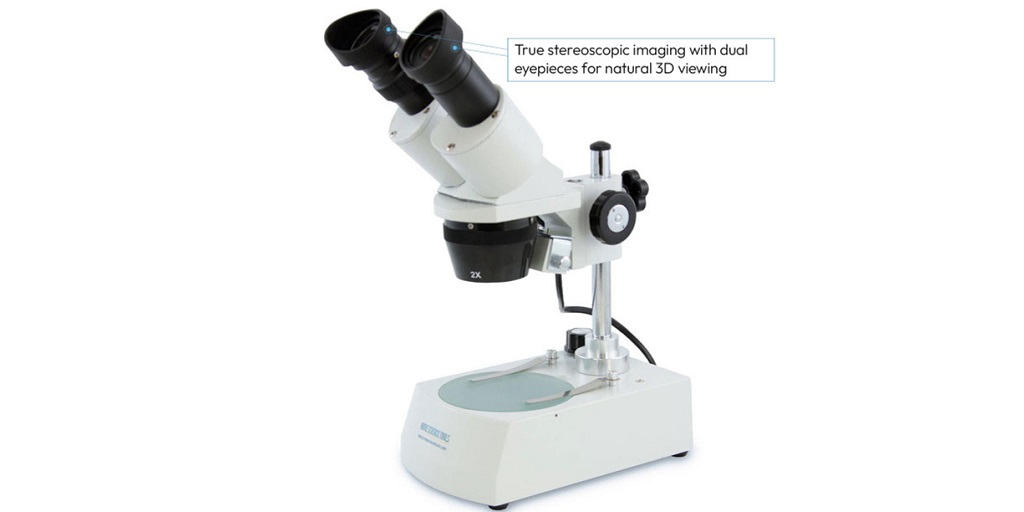
If this is your first time coming across the term “dissecting microscope,” you might be inclined to think that it’s a tool reserved for scientists in pristine white lab coats. What you might not know is that it’s actually one of the most approachable and exciting tools that you can introduce to a child. It gives young explorers the chance to look closely at the everyday world in a way that sparks curiosity and wonder. Continue reading to discover what a dissecting microscope is and how it can be a valuable learning tool for children.
What Even Is a Dissecting Microscope?
A dissecting microscope, also known as a stereo microscope, is a type of microscope designed for viewing objects at low magnification. Instead of flattening everything into a single image, as many traditional microscopes do, it uses two separate optical paths. This gives the viewer a three-dimensional view which feels more natural and easier to understand, especially for children.
Because it works with lower magnification, a dissecting microscope doesn’t require thin slices of samples on special slides. You can place solid, everyday objects right under the lens: leaves, shells, rocks, coins, feathers, even pieces of fabric. To operate the microscope, kids simply have to set the object down and look. This simplicity makes using the microscope less intimidating and creates a much more hands-on experience.
A Tool That Brings Learning to Life
Children learn best when they get to explore the world around them directly. A dissecting microscope turns that exploration into something unforgettable. When a child sees the tiny hairs on a caterpillar or the intricate veins on a leaf or flower petal, it creates a powerful “wow” moment and a sense of discovery that encourages them to keep asking questions.
Because the microscope offers a clear, three-dimensional view, kids can connect what they see in the microscope to the objects they hold in their hands. It helps them understand structure, texture, and detail in a way that feels grounded in the real world. Abstract concepts suddenly become tangible.
Encouraging Curiosity Through Everyday Objects
One of the biggest advantages of the dissecting microscope is that children don’t need complicated materials to get started on using one. A walk in the backyard or a trip to the local park becomes a scavenger hunt for new things to examine. A pinecone transforms into a pattern of repeating geometric shapes. A grain of sand reveals colors and crystals that were once invisible. Even ordinary household objects, like the edge of a book or the threads of a sock, become fascinating when magnified.
When kids begin to realize that anything can be an experiment, they naturally develop the habit of paying closer attention to the world around them. It’s a habit that often leads to deeper curiosity and a more active way of thinking.
Purchase a Dissecting Microscope for Your Child on Home Science Tools
Introducing a child to a dissecting microscope is like giving them a passport to a hidden world. The more they explore, the more they realize how much there is to learn. That growing fascination often becomes the spark that inspires future interests, whether in science, nature, engineering, or simply the joy of observing more closely.
You can give any child aged 8 and above a dissecting microscope. Find a suitable one today by visiting Home Science Tools.
