
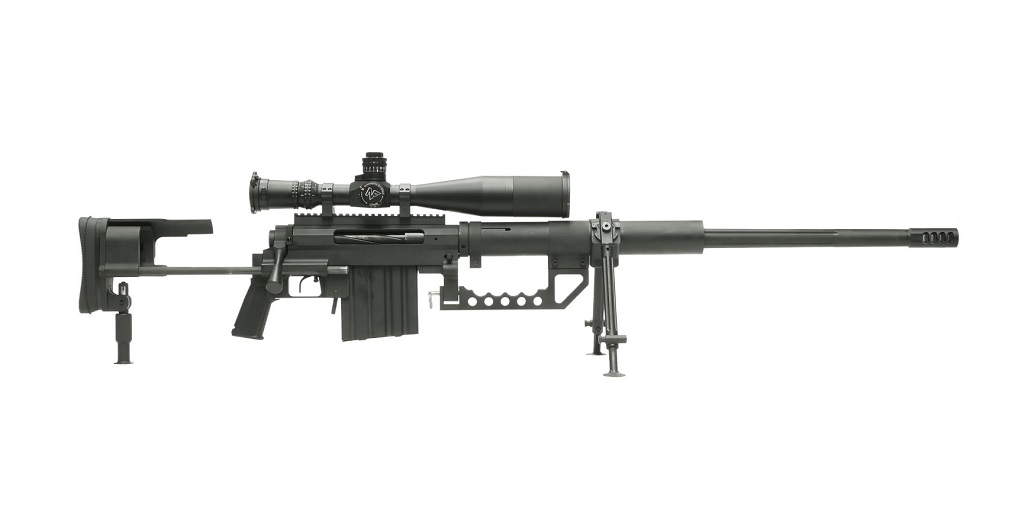
The CheyTac M 200 Intervention rifle offers pinpoint precision at extreme ranges and is capable of engaging man-sized targets at ranges greater than 2500 meters.
This is due mostly to the extreme tolerances according to which the rifle and the ammunition it shoots are manufactured.
Interestingly, you might expect some serious recoil from the larger of the two cartridges with which the M 200 Intervention is chambered, the .408 CT.
But the truth is that these are quite large, fairly heavy platforms, and the weight of the rifle alone absorbs the vast bulk of recoil.
Still the rifle is made with a threaded barrel and typically comes with a muzzle brake. Here’s what you need to know about these muzzle brakes and suppressors, another common muzzle device paired with long-range rifles.
Muzzle Brakes
Muzzle brakes are probably the most common muzzle device encountered with long-range rifles, and they are definitely the most commonly paired with M 200 Intervention rifles.
Just in case you’re not familiar, a muzzle brake is a muzzle device that contains ports (commonly they are radial, which means they are distributed about the radius of the device, in circular fashion) that redistribute how gasses are ported at the muzzle.
Because muzzle brakes change the configuration in which gasses are ported at the muzzle, they can significantly cut back on felt recoil. In the case of a quality muzzle brake, felt recoil can be cut by as much as 50%, although that is an extreme case. Figures in the area of 30% to 40% are also common.
There is another thing to be aware of with muzzle brakes, and it has to do with muzzle jump. Some muzzle brakes have ports at the top of the device, which specifically port gasses upward at the muzzle, redirecting the force of felt recoil down on the end of the muzzle.
These types of muzzle brakes don’t just diminish felt recoil, they actually help to counteract muzzle flip, too – not a huge deal on a bolt-action like an M 200 Intervention, but something to consider with handguns and gas-operated rifles like ARs.
The one thing to remember with a muzzle brake is that, although they do cut felt recoil, they make muzzle blast and overall volume a lot worse. So just be prepared for a significant increase in muzzle blast if you shoot a rifle that has one.
Suppressors
Suppressors are another common muzzle device, albeit slightly less common because they are NFA items and a little bit harder to get.
Like a muzzle brake, a suppressor typically attaches to the muzzle via threads, but in the case of a suppressor, there are a series of internal vanes and baffles that help trap and redirect expanding gasses (or both).
Therefore, the primary effect of a suppressor is that the volume and the muzzle blast of the gun will be considerably diminished. Hence the common name, “silencer.”
But there is more to the function of a suppressor than this. Because they trap and redirect gasses at the muzzle, they can also cut back on felt recoil and muzzle jump. Not by as much as a muzzle brake, but still in the area of 10% to 30% reduction.
And, another cool thing about suppressors is that they actually boost bore pressure, so the muzzle velocity of the bullet gets a slight jump, too. That is, suppressors add a little bit of power to the rifle.
Which ultimately means you get all the benefits of a muzzle brake with a suppressor, and some you wouldn’t get with just a brake alone.
Where to Learn More About the M 200 Intervention
Interested in learning more about the M 200 Intervention and its specifications? Visit B&B Firearms or get in touch with them directly for more assistance. They may also be able to help answer any questions you have about suppressors and muzzle brakes.
For more information about Tac338 and Armalite Ar 50 Bmg Please visit: B&B Firearms LLC.
