
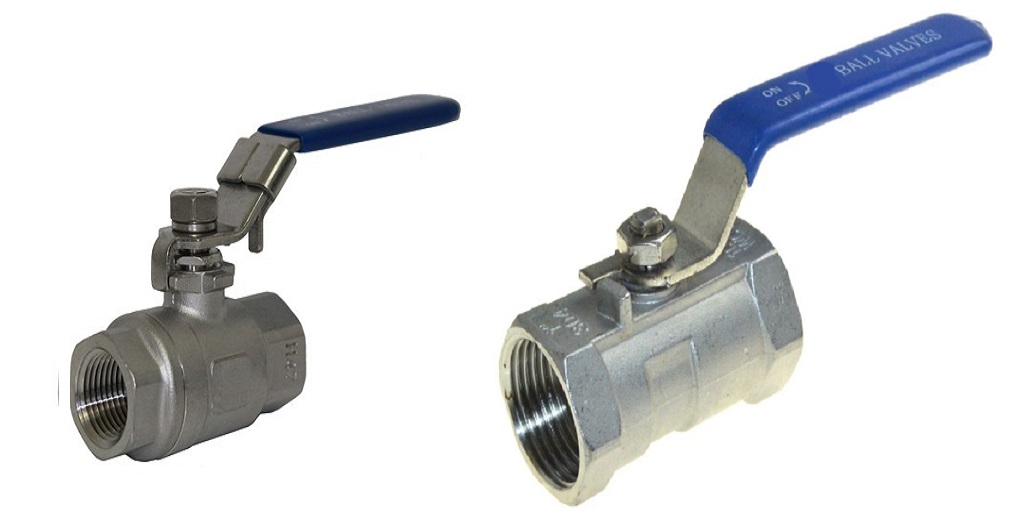
The “SS” in SS ball valves stands for stainless steel, one of the most effective alloys in terms of performance, strength, and durability, used for making ball valves and other pipe fittings used in commercial and industrial applications. Stainless steel (despite the fact that it varies widely in chemical makeup) is also highly preferred in applications in which sterile protocols are necessary, such as in brewing, pharmaceutical and chemical applications.
The basic design, easy operability, simple maintenance and reliability of SS ball valves also make them preferential to other types of valves in many applications.
All ball valves, stainless steel or otherwise, operate according to the same basic principles. They consist of a fitting that contains a hollow, bored-out pivoting ball that is connected to a handle and which controls the flow through the line it regulates.
By turning the handle a quarter turn so that it is perpendicular to the pipe, the ball rotates and shuts off the flow through the fitting. When the handle is in line with the fitting and pipe, flow is restored. They are highly practical in situations in which a simple “on” or “off” flow setting is necessary.
One of the main advantages of SS ball valves is that these fittings can be used without creating a pressure differential. Since they allow the inner diameter of the pipe to be effectively unrestricted, use of the valve doesn’t create significant pressure drop on either side of the line.
Though they do require manual operation, they can be activated quickly. A single quarter turn shuts off the flow – as compared to other types of valves which require several revolutions to completely arrest the flow.
The simplicity of the design also eliminates the need for lubrication, and there is little to no chance of leakage. These types of valves are reliable and virtually leak-free.
Now, with respect to SS ball valves, they require little to no maintenance and since they are made from durable and corrosion resistant stainless steel, they require little to no attention once installed.
Many SS ball valves are made with a grade of stainless steel known as 316, which is an austenitic stainless steel alloy similar to 304 (also commonly used in commercial and industrial applications) but with the addition of molybdenum.
Like its cousin 304, 316 stainless steel is highly corrosion resistant thanks to high concentrations of both chromium and nickel. However, the addition of molybdenum not only adds strength but improves the alloy’s corrosion resistance, specifically with respect to acids, alkalis, and chlorides.
This makes SS ball valves made from 316 stainless steel ideal in many industries and applications, including but not limited to foodservice, processing, brewing, pharmaceutical and chemical manufacturing, and marine applications, among others.
High Quality SS Ball Valves Online
Here not for steel chemistry, but to find a new supplier of SS ball valves? Put Proflow Dynamics in your rotation. They sell a wide range of ball valves along with camlock fittings, as well as other threaded pipe fittings, check valves, strainers, and more.
For more information visit their website or get in touch with them at sales@proflowdynamics.com.
