
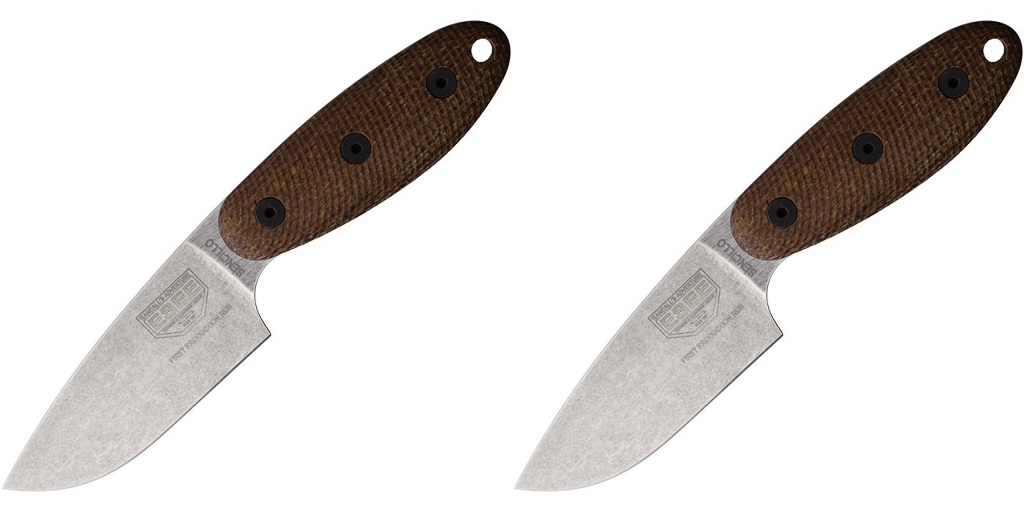
ESEE Knife models like the ESEE 3, 4, Junglas and Izula are immortal. As long as these knives are produced by the company, there will be willing buyers that are proud to carry and use them.
The bread and butter of ESEE knives is a twofold approach. One is keeping the design basic, the other is the use of powder-coated 1095 steel.
Now, granted, there are special ESEE knives that are offered in special configurations with steels other than 1095, but the following two models are conspicuously offered in their standard lines without it. Here’s how these knives make a big impact.
The ESEE Sencillo
The ESEE Sencillo is the knife for lovers of the Izula that wished for two things to be a little different: that it was slightly bigger and that it used different steel.
The Sencillo is larger than the Izula without feeling like a burden. It’s still small and lightweight, and features all of the things ESEE fans have loved about the Izula; the drop point, the comfortable handle (which is slightly larger, rounder, and even more comfortable in the Sencillo) plus ergonomics that are overall more favorable for users with larger hands.
Basically, the Sencillo is a bigger version of the Izula made with super steels. The two main variants of the Sencillo are made with A2, a tough tool steel, and Magnacut, a super steel that offers better general toughness, as well as edge retention and corrosion resistance.
The long and short of it is that if you love the Izula but want something slightly larger and made with what most would agree are better materials, get yourself a Sencillo.
The ESEE Pacaya
If the ESEE Sencillo is an upgraded version of the Izula, then the ESEE Pacaya is an upgrade to the venerable and time-tested ESEE 3.
Likewise, the Pacaya offers about everything the ESEE 3 does with a few upgrades.
For one, just like the ESEE 3, it has a 3” flat-ground blade with a drop point and a straight edge. But where the 3 has a shorter, somewhat less ergonomic and less versatile handle, the Pacaya has a more generous, 4.125” handle.
It also sports Micarta scales, but the form factor of the Pacaya’s grip is much-softened by comparison to the ESEE 3, and as a result not only more comfortable to use, but more versatile in a wider range of different grips.
Then there is the steel: the Pacaya is primarily made with a CMP-3V super steel that is rich in carbon, chromium, and molybdenum, along with carbide-forming vanadium. With a proper heat-treatment, 3V steel offers excellent impact resistance and general toughness, as well as solid edge retention and corrosion resistance.
It can prove to be just a bit difficult to sharpen, but beyond that, it’s a solid super steel by any stretch of definition. Plus, the upgrade in steel has enabled ESEE to forgo the powder coat finish, which makes the blade slicker, easier to clean, and better for food prep.
All else, including sheath and mounting options, as well as general size and weight, of the knives are very similar. It’s just that the Pacaya offers what some brand loyalists would call a welcome upgrade to a time-tested model; they didn’t replace the ESEE 3, they just made a comparable model that played to its strength while improving on other attributes.
Want to Learn More About These ESEE Knives?
Want to learn more about these ESEE knives that other models from the brand? Visit White Mountain Knives to see their full catalog and if you’re looking for something you don’t see listed, get in touch with them at WhiteMountainKnives@gmail.com for more information.
