
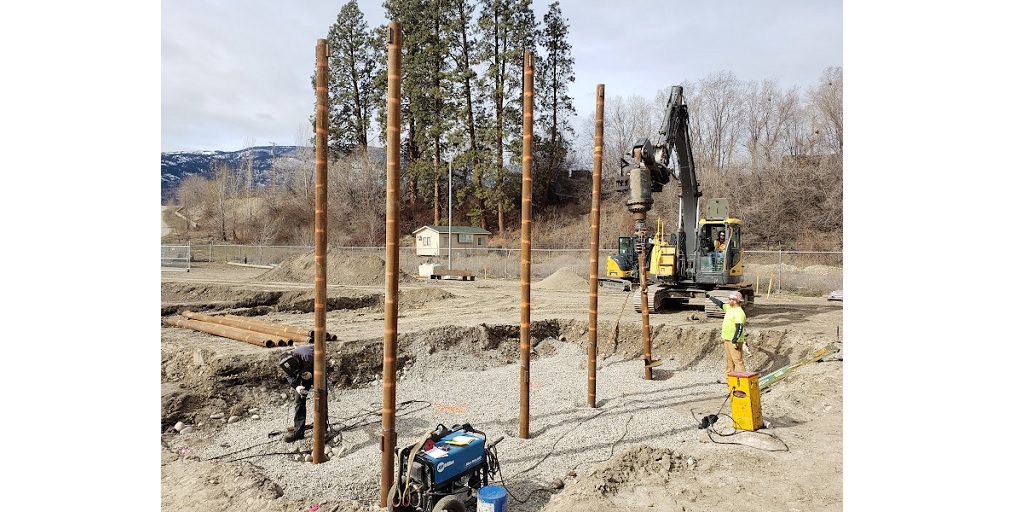
Essential for supporting structures in diverse soil conditions, helical piles need precise load calculations to ensure safety, stability, and performance. Whether you’re working on residential, commercial, or industrial projects, understanding how to calculate loads for helical piles is crucial for achieving optimal foundation design.
1. Types of Loads on Helical Piles
Helical piles are designed to bear two primary types of loads: compression and tension.
- Compression loads push down on the pile, exerting force on the pile’s base. This type of load typically occurs in foundational support for structures such as homes, buildings, or even large equipment.
- Tension loads, or uplift loads, exert an upward force on the helical pile. These loads are common in areas with expansive soil or in applications where structures are subject to lifting forces, like retaining walls, towers, or decks.
. Determining Load Capacity: Key Factors
Several factors influence the load-bearing capacity of a helical pile, each affecting its performance based on project requirements and site conditions. Here are a few important ones:
- Soil Type and Density. Soil characteristics such as type, density, and moisture content play a significant role in determining load capacity. Dense, cohesive soils tend to provide higher resistance, while loose, sandy soils may reduce the overall capacity.
- Pile Diameter and Helix Size. The size and number of helices (the screw-like plates on the pile shaft) also impact load capacity. Larger helices create more surface area, allowing for greater bearing capacity, which is essential in achieving the required load support.
- Depth of Installation. The deeper a helical pile is driven, the more stable it becomes. Installing helical piles at the correct depth minimizes the risk of soil shifting and load displacement, leading to a stronger, more durable foundation.
- Pile Spacing and Group Effect. When using multiple helical piles, the spacing between each pile influences load distribution. Piles positioned too closely may experience load interference, reducing their individual capacity.
3. Calculating Compression Load Capacity for Helical Piles
Calculating the compression load for helical piles involves assessing the load that the pile’s shaft and helix plates can bear. A commonly used formula to calculate the ultimate compression load (Q) is:
Q = As x fs + Ah x qs
Where:
- As is the surface area of the shaft in contact with the soil,
- fs is the adhesion or friction between the shaft and soil,
- Ah is the area of the helix plates, and
- qs is the bearing capacity of the soil on the helices.
These calculations help determine the load-bearing limits of the helical pile under compressive forces.
4. Calculating Tension Load Capacity for Helical Piles
To calculate the tension load capacity, a similar approach is taken as with compression, but it focuses on the pile’s resistance to pulling forces. The formula generally includes adhesion factors and the pile’s depth, as deeper installations reduce the likelihood of uplift movement.
Factors that enhance the tension capacity include:
- Increased helix diameter. Larger helices improve the pile’s ability to resist uplift.
- Higher pile embedment. The deeper the pile is installed, the more soil acts as a stabilizer against upward forces.
5. Load Testing: A Practical Approach
Load tests simulate real-life conditions by applying incremental loads to the pile and measuring its response. These tests can identify discrepancies between calculated and actual load-bearing capacities, allowing for adjustments and increasing confidence in the foundation’s design.
6. Role of Torque in Helical Pile Installation
During installation, the torque applied to screw a helical pile into the ground is directly correlated to its load capacity. Generally, higher torque indicates greater soil resistance, which translates to higher bearing capacity. By monitoring the installation torque, engineers can estimate the pile’s capacity and adjust the installation process as needed.
By thoroughly understanding load capacity and using a combination of theoretical calculations and load testing, construction teams can confidently incorporate helical piles into their projects, ensuring optimal stability and performance.
