
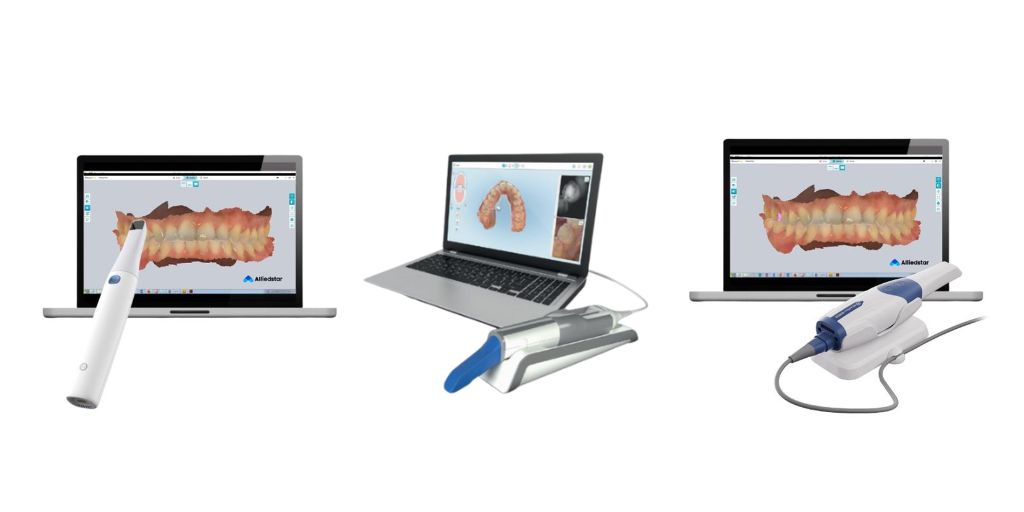
Intraoral scanners have changed the game for many dentists and specialists. No more traditional molds! Share an easy-to-capture digital scan with ease with today’s leading scanner brands.
Today, we’re talking about the most common use cases for intraoral scanners. Practices are increasingly making the investment in these game-changing imaging devices. Here are some of the best of them.
- Restorative Dentistry: for restorative procedures, such as the creation of crowns and bridges, a detailed, 3-dimensional view of the patient anatomy is requisite. However, traditional methods are time consuming, inconvenient and often uncomfortable for the patient, and incur long, drawn-out workflows. Using an intraoral scanner to capture a scan of the patient’s mouth in real-time is faster and more efficient, resulting in faster turnaround. The use of these dental scanners also allows the data to be exported quickly to the lab – rather than shipping a physical impression – further improving the efficiency of the overall workflow.
- Implant Dentistry: Intraoral scanners enable the capture of more accurate scans to help ensure that implants fit properly within the patient’s mouth, accounting for their anatomy. This reduces the risk of implant failure and the need for retreatment.
- Orthodontics: Not only the speed and comfort, but also the accuracy of an intraoral scan makes the production of clear aligners, braces and mouthguards more efficient and effective. The 3D impression taken from the patient’s mouth can be sent directly to the lab for printing, with faster turnaround time. Also, the accuracy of a digital model is unimpeded by the risks of taking a physical impression, which can be not only inaccurate, but also at risk of damage or deformation which will yield ill-fitting orthodontic appliances.
- Patient Visualization and Treatment Acceptance: Sometimes the most harrowing aspect of any course of treatment is simply getting the patient to agree to it in the first place. Dental scanners produce highly detailed images that can be useful for chairside visualization and explanation, improving patient involvement, engagement, and treatment acceptance.
Why Intraoral Scanners?
As more and more dental practices around the country adopt the technology of intraoral scanners, you might be wondering if your practice needs one. In addition to the use cases listed above, here are some of the advantages associated with dental scanners:
- Increased accuracy: Digital intraoral scanners can capture the patient anatomy in exceptional detail, more accurately than physical impressions, and the images captured cannot be physically damaged in the same way impressions can.
- Patient experience: The speed and comfort associated with taking an intraoral scan are much more attractive to most patients than taking physical impressions.
- No radiation exposure: Unlike most digital dental X-ray machines, intraoral scanners use visible light, not ionizing radiation, to capture scans of the mouth.
- Fast turnaround time: Some dental scanners can capture full-arch scans in under a minute, much faster than taking a physical impression. Also the files can be exported directly to a lab, further increasing efficiency.
- No waste: Physical impressions consume the physical impressioning media, and also take up a lot of space. This is not associated with intraoral scanners, or with the files they produce of the scans they capture.
Get Started Saving 30% to 50% on Industry Leading Intraoral Scanners
Thinking about taking the leap forward by outfitting your dental practice with a digital intraoral scanner? Visit Renew Digital; they save their customers anywhere from 30% to 50% off the leading brands that dentists trust most, and will even help train your staff to shorten the learning curve associated with the adoption of new imaging equipment.
For more information about Dental Cbct and Panorex X-Ray Machine Please visit : Renew Digital, LLC
