
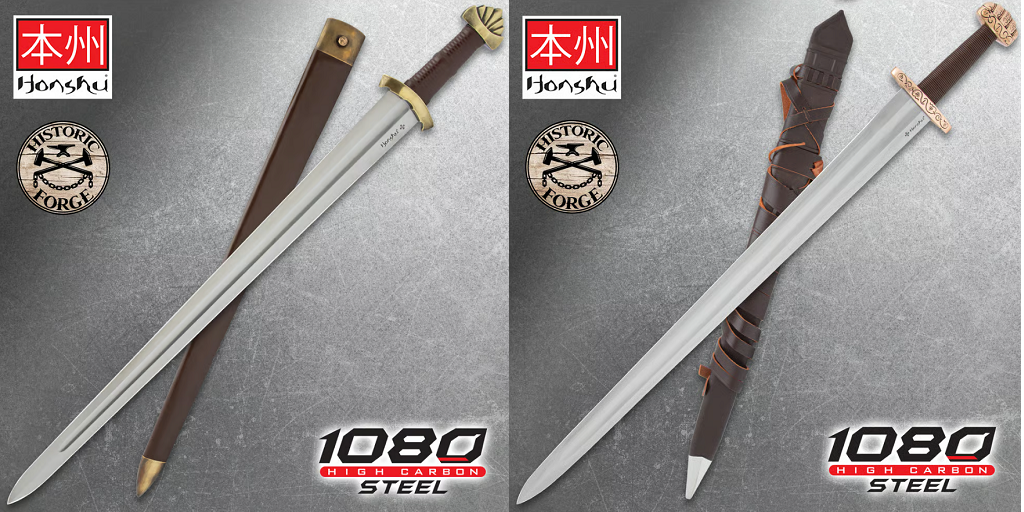
Viking swords, less commonly referred to as Carolingian swords, and sometimes referred to as Norman swords, depending on the pattern, are indelibly linked in the pop culture mind with the image of a burly, bearded, horn-helmeted Northman, perhaps wearing a bear sark.
But if you want to get a real Viking sword – real in the sense that it’s usable, not that it’s a 1000-year old historical artifact – make sure you know what to look for and what questions to ask so you don’t throw good money after bad. This very short guide should get you most of the way there.
What Distinguishes a Viking Sword?
While there really isn’t any hard definition, there are a few things you can look at that more or less typify a Viking sword.
One is a mid-length double-edged blade with a wide fuller. Generally, Viking swords were one-handed, so the blade would be between 20 and 30 inches – somewhere in there. The point could be either sharp or somewhat rounded, giving these sword patterns good utility not only for slashing but for thrusting.
As they were intended to be one-handed patterns, the hilts were usually fairly small and cramped, only offering enough room for a single hand.
The hilt itself should be, all else considered, the most distinguishing feature of a Viking pattern sword. Usually, the crossguard would be straight or slightly forward-sloping or curved, the hilt itself would be made of wood wrapped in leather, and the pommel would have either a single, wide, nut or lozenge-shaped lobe, or three or five rounded lobes.
Sometimes, the hilt of a viking sword would be elaborately decorated with engravings, inscriptions, or precious metals.
What Does a Battle Ready Viking Sword Need?
In order to be considered a battle ready sword, it should be made of an appropriate alloy (high-carbon) with a suitable temper that enables it to flex without taking a set. The blade should also be tempered so that when struck it is strong enough, but not so hard to the point that it chips or snaps.
The construction of the tang is also critical. It should be a full tang, or at least a third the width of the blade, and the tang should be contiguous with the blade stock, not welded on.
These three traits are among the most important for any sword to have, and all battle ready swords have them. Anything less and you have a wallhanger, not a real sword.
What Steel Should a Viking Sword Be Made with?
You have a bit of flexibility here as there are many steel alloys that make suitable sword blades, for their strength, wear-resistance, and ability to take an appropriate temper.
Some of the more common alloys used in the manufacture of battle-ready swords are 1060 and 1080. Others are made with slightly higher or lower carbon steels, like 1095 or 1055, respectively.
Some Viking swords are also made with Damascus and spring steels, which can be very strong and hard, yet flexible if heat treated with an appropriate temper. These are also acceptable.
Lower carbon, higher chrome steels are acceptable for sword-like objects made to be displayed, but these should never be used for live practice.
Where to Get Your Next (or First) Viking Sword
If you’re in the market for a real Viking sword, visit True Swords. They carry a wide range of interesting sword patterns, along with other historical Viking weapons and accoutrements like seax knives and drinking horns.
Whether you’re an educator, collector, or just a general enthusiast, they have a lot of cool stuff that’s also very high quality. Check out their collection today and get in touch with them directly if you have any questions before buying.
For more information about Samurai Sword Cane and Katana Damascus Blade Please visit: True Swords.
