
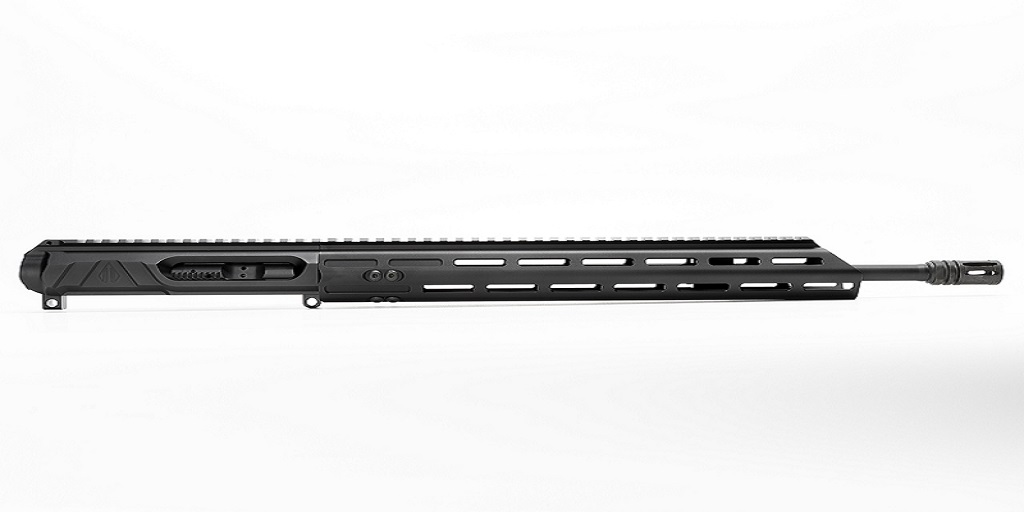
For shooters tired of the shortages of guns and ammo, resorting to making your own build from a complete upper and a lower, or a build kit, may be a welcome option.
With that said, the project can be a little intimidating for some shooters that have never built a rifle before, and are more or less just used to filling out 4473s, waiting for the NICS check to come back, and taking the gun home.
So, let’s cover some of the high level questions about rifle builds.
Breaking Down a Complete Upper
If what you’re looking at truly is a complete upper, it should come with:
- The stripped upper itself, to which all other parts attach.
- A barrel, installed on the upper. If the barrel is threaded it should come with either a muzzle device or thread protectors.
- A gas system, which provides the potential energy to cycle the bolt carrier group.
- A handguard or rail system of some sort.
- A bolt carrier group, assembled, with all components, with a charging handle. If it is a side charger it might not have an ejection port cover but rear chargers should come with one.
From a high level (not getting down into the details of the spring, pins, fasteners and other hardware) if the upper you’re looking at has all of these components, it’s more or less ready to pair with a lower to create a functioning firearm.
Are There Any Upper Parts That Don’t Come with a Complete Upper?
If it truly is a complete upper, then it should be ready to mate to a compatible, complete lower, and result in a finished, functioning rifle.
However, not all “complete” uppers are the same, and sometimes uppers come without muzzle devices, bolt carrier groups, charging handles or ejection port covers, so make sure you read the description carefully so you know what’s included.
Does a Complete Upper Require an FFL Transfer?
You may be familiar with the fact that most firearm receivers are the part that is serialized and therefore considered a “gun” by the ATF. AR-style rifles have two receivers; an upper and a lower. The lower is the component that is serialized and regulated as a firearm, not the upper, so as a result, you can purchase a complete upper without an FFL transfer or NICS check.
What Else Do You Need to Complete the Build?
In order to complete a build with an upper, you also need a complete lower parts kit and a lower receiver. There are two main options for lowers, which are complete lowers and 80% lowers, also called receiver blanks.
Complete vs. 80% Lowers
A complete lower is a finished lower receiver. After installing all the parts and hardware, you can pair it with a complete upper to make a functioning rifle. You will need an FFL transfer to purchase a complete, stripped lower.
The other option is an 80% lower, also called an 80 lower or a receiver blank. An 80% lower lacks the pinholes for the hammer and trigger, does not have a hole for a safety selector lever, and does not have a cavity for the fire control unit.
An 80% lower must be machined before it can be used to assemble a functioning rifle. For this, most people use either a drill, drill press, or router, along with an 80% lower jig which serves as a template for the process. Once completed, it can then be used to assemble a functioning rifle.
Note: while it is federally legal to own and alter an 80% lower, many states have enacted laws forbidding their sale, possession, or alteration. If you are uncertain, be sure to consult an experienced firearm lawyer in your area before proceeding.
For more information about Left Handed Upper and Ar Side Charging Upper Please visit: Gibbz Arms.
