A homeschool science curriculum allows students to explore biology, chemistry, physics, engineering, and environmental science, making it an excellent foundation for STEM education. When children can read about a concept and test it with an experiment, learning becomes more meaningful and memorable.
Hands-on activities promote curiosity while helping students develop scientific habits. They learn to ask questions, record results, identify patterns, and explain their conclusions with evidence. These experiences enhance skills that support future learning in many subjects.
Chemistry Connects Science to Everyday Life
Chemistry appears in daily routines, even when you may not notice it. Cooking, cleaning, gardening, and weather all involve chemical processes. Exploring these examples helps students recognize that science is part of the world around them.
A structured science curriculum introduces each topic in a logical order. Students begin with simple concepts such as states of matter and physical changes before moving into reactions, mixtures, and chemical formulas. Each lesson builds on previous knowledge, making new ideas easier to understand.
Practical experiments also give students a chance to observe real changes rather than relying solely on diagrams or written explanations. Watching a reaction happen creates lasting connections between theory and practice.
Hands-On Learning Encourages Better Understanding
Reading science concepts provides valuable background knowledge, but experiments allow students to see those ideas in action. Measuring liquids, mixing safe chemicals, and observing reactions encourage careful attention to detail while making lessons more engaging.
Lab activities also introduce important scientific habits. Students learn how to:
- Follow directions carefully
- Measure materials accurately
- Record observations clearly
- Compare results with predictions
- Draw conclusions based on evidence
These experiences help build confidence because each completed experiment reinforces classroom learning with direct observation.
Organized Lessons Support Different Learning Stages
Students learn at different speeds, and chemistry instruction should reflect those differences. A curriculum designed for specific age groups presents information at an appropriate level while gradually increasing complexity.
Younger learners may begin with simple observations about solids, liquids, and gases. Older students can investigate atomic structure, chemical equations, and reaction types with greater depth. This gradual progression helps learners stay motivated while expanding their scientific knowledge.
Well-organized lesson plans also reduce preparation time. Clear instructions, guided activities, and structured experiments help you focus on supporting your student’s learning experience instead of gathering materials or creating lessons from scratch.
Lab Kits Bring Chemistry to Life
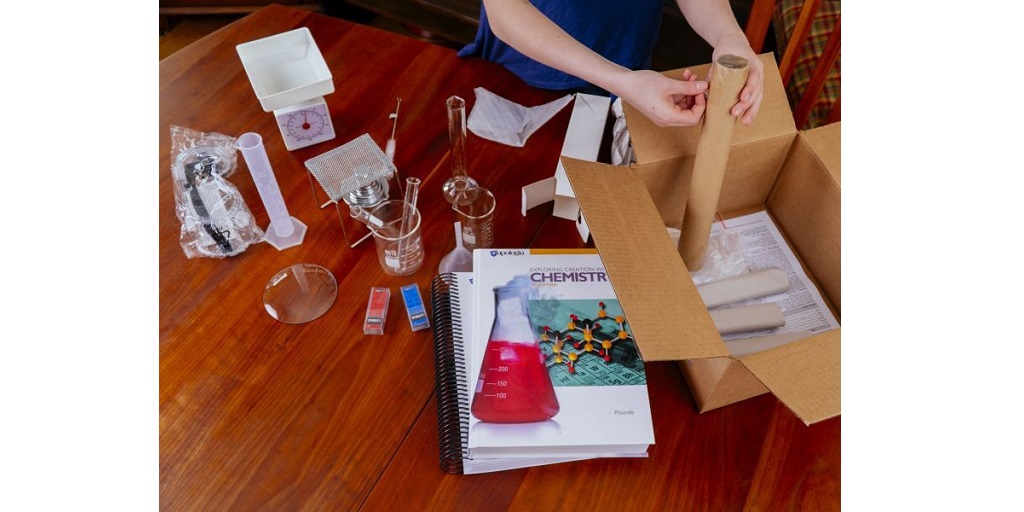
Lab kits provide the supplies needed for meaningful experiments in a homeschool setting. Having materials prepared in advance allows students to begin investigating concepts without unnecessary delays.
Safe chemical supplies, laboratory tools, and detailed experiment guides help students complete activities with confidence. As they perform each experiment, they strengthen observation, measurement, and analytical thinking.
Completing labs alongside lesson materials also helps students connect scientific vocabulary with practical experience. Terms such as solution, reaction, compound, and mixture become familiar to students as they see each concept demonstrated in experiments.
STEM Skills Grow Through Scientific Investigation
Chemistry supports many valuable academic skills beyond the field of science itself. Students practice reading instructions carefully, solving problems step by step, organizing information, and interpreting results.
Many experiments encourage simple calculations, introducing opportunities to apply mathematics in meaningful situations. Recording observations develops writing skills, while discussing conclusions strengthens communication. These connections help students understand how different subjects work together.
Scientific investigation also encourages patience and persistence. When results differ from expectations, students learn to review procedures, identify possible causes, and repeat experiments carefully. This process builds resilience while strengthening critical thinking.
Find Resources That Support Your Science Journey
Choosing quality materials makes chemistry easier to teach and more enjoyable to learn. Home Science Tools offers homeschool science curriculum options and lab kits designed to help students explore chemistry through structured lessons and practical experiments. Whether your learner is beginning with basic concepts or advancing into more detailed studies, you’ll find resources that support confident, hands-on STEM education.