
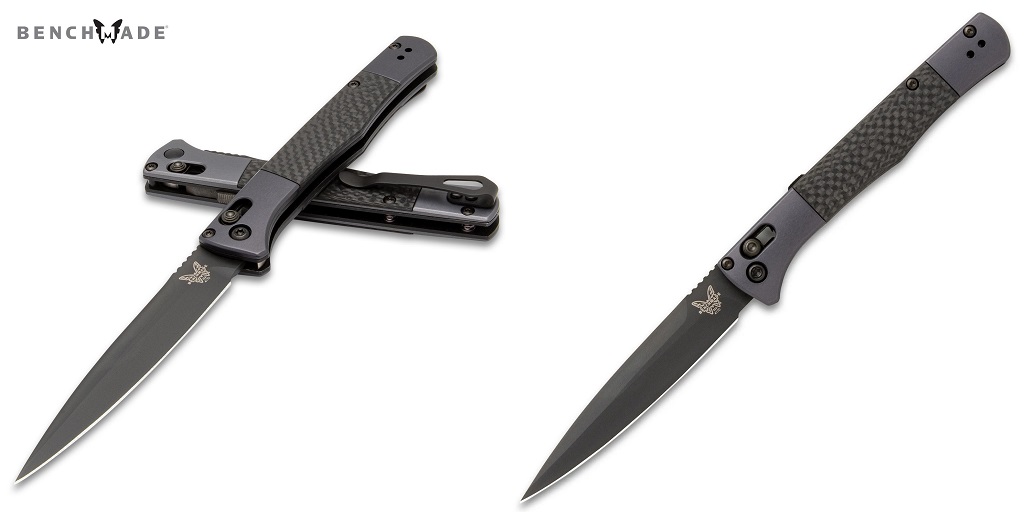
There was a time when most folding knives were not equipped with locking mechanisms. Even today, many are obligate slip joint folders and do not lock.
Even after that, for a while, pretty much the only available folding knife lock types were rotating collar locks and pioneer locks like the lockback of Buck Knives 110 Folding Hunter.
It wasn’t until nearly the nineties that a knife lock would utterly change the industry, and that knife lock was the AXIS lock of Benchmade Knives, that has since been remade countless times.
But how does this lock work, and why is it better than alternatives?
About the AXIS Lock
The AXIS Lock, which was developed by Benchmade, consists of a bar that rides in between the knife scales and liners, and which is held in place with a U or omega-shaped spring.
When the knife is opened, the bar lock slides forward into a recess in the base of the blade and is held in place with the spring.
The AXIS Lock, which is generically known as a bar or crossbar lock, is superior on many fronts than other folding knife lock types.
One is the strength, and that is its strongest attribute (no pun intended). Crossbar locks are considerably stronger than pretty much any other type of knife lock, including but not limited to lock backs, liner locks, frame locks, and button locks.
It is effectively impossible to get a bar lock to fail except by a complete failure of the knife itself. The strength of the AXIS Lock cannot be overstated except through extreme hyperbole.
Even if it were not for the incredible strength of an AXIS Lock, this type of mechanism is superior on several other fronts.
One is the ergonomics of the AXIS Lock. For one, they are intuitive, and for another, AXIS Locks do not favor either right or left handed users like some other types of locks.
They are equally amenable to both right and left-handed users, unlike liner or frame locks, which inherently favor one or the other.
AXIS Locks are also inherently safer, and not just because of the strength. An AXIS Lock enables a user to disengage the lock and close the blade without putting the fingers in the path of the blade.
On top of that, it is effectively impossible to get a bar lock to unintentionally disengage, which further improves safety.
For instance, some locks, such as liner and frame locks, can accidentally disengage, allowing the knife blade to fold, if the knife is twisted or torqued a certain way.
In addition to that, crossbar locks such as AXIS Locks can be easily engaged or disengaged with one hand, and again, it doesn’t matter which one.
Some lock types, such as lock backs, require two hands to close. Crossbars can be opened and closed with one.
All of this being the case, it should be clear that these lock types are far and away the best on the market.
They are easier to use, are truly ambidextrous-friendly, do not disengage unintentionally, are intuitive and fidget-friendly, and most importantly, are safer and stronger than other folding knife lock types.
That’s pretty much all there is to it.
Explore Benchmade Knives and More
Thinking you want to add some Benchmade Knives to your collection if you don’t have any yet? Visit BudK; they carry a bunch of popular models from Benchmade, including some of their automatic models like the Shootout and Claymore, among others.
Check out their website and get in touch with them if you have any questions.
For More Information About Machete Knife and Pocket Knives Please Visit: BudK Worldwide Inc.
