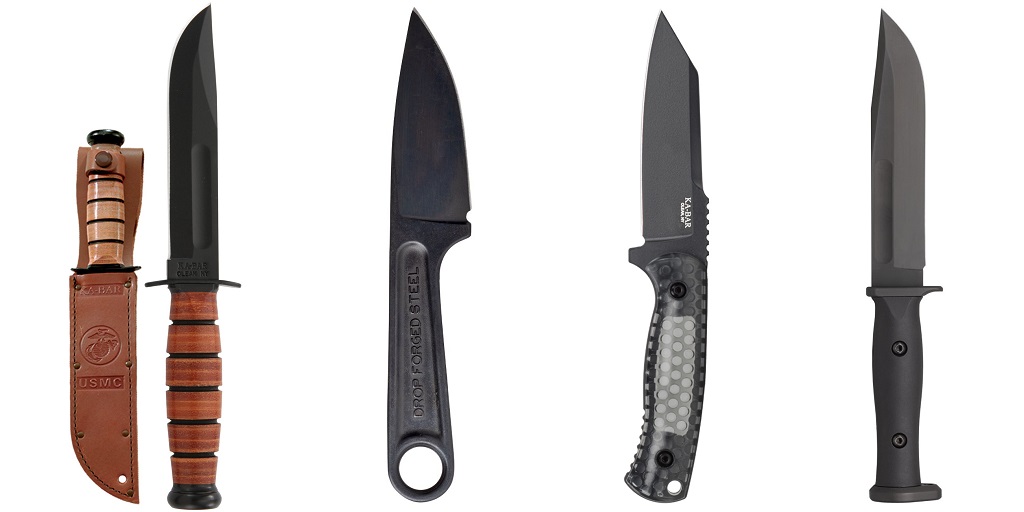
Best known perhaps as the USMC fighting knife, the KABAR, today produced by Becker Knives, is one of the most recognizable patterns in history, which has been ripped off and reproduced ad infinitum since it was first introduced nearly 100 years ago at this point.
But what makes it such a popular pattern, besides its mystique (which, in fairness, contributes no small amount to the matter of its popularity)? Let’s take a closer look.
The Classic KABAR: Practical but Simple
The 7 inch blade of this classic knife isn’t just intimidating, it’s practical. Equal parts fighting knife and utility tool, the clip-point blade is effective for piercing and thrusting maneuvers, as well as detail work like carving.
Add to that the thick blade stock (.165”) and a generous length of edge, and you can do a lot with this knife besides fight. It can be used for draw cuts, push cuts, shaving cuts and scraping, and a lot more. You could even use it as a baton.
Of course, a not insignificant amount of value is driven here by the steel. Becker calls it 1095 Cro-Van, which basically means that it is 1095 but with additional chromium and vanadium.
Which is not something to gloss past. The chromium adds considerable rust resistance to the alloy, which is a big deal because normally 1095 is a rust magnet, and the vanadium significantly improves the toughness and wear resistance of the steel.
This is partly due to the fact that vanadium is a dense, hard element, and partly due to the fact that it combines with carbon to form carbides, which harden the steel and improve its grain structure and consistency.
So far we have a solid pattern and a utilitarian knife blade profile that is effective for fighting as well as for general chores and tasks, as well as a steel alloy that, though cheap, hits hard.
The handle of the KABAR is one of its most recognizable features. Whereas many other knives are made with wood or synthetic scales, the KABAR fighting knife sports a stacked leather handle.
While a little harder to maintain, the stacked leather handle is unbelievably comfortable in the grip, even when wet, and even at low temperatures. Naturally, it has soft contours and feels a lot more yielding in the hand, almost even warm, for lack of a better word.
Other features of the knife improve its ergonomics and general utility. For instance, a smooth pommel improves grip and retention, and a small crossguard helps prevent the hand from slipping up and over the blade during use.
The sheath is another thing to love about this knife, even though it’s dated in design and material. It comes with a heavy leather sheath. While it won’t offer a good friction fit like a modern Kydex sheath, is it soft, comfortable, silent, and perhaps most importantly, it’s downright beautiful. And, at the end of the day, it’s practical, too.
All in all, the KABAR fighting knife might not ever win any contest for “best knife design of all time” but one thing pretty much anyone can agree with is that it is a classic knife that still performs, nearly 100 years after its introduction.
Explore This and Other Becker Knives and Tools at The Knife Connection
Want to add a KABAR to your collection, or learn more about other patterns from Becker Knives? Visit The Knife Connection and take a closer look at what they offer. They carry a wide range of patterns from this brand and others and if you have any questions about what they sell you can contact them; they’ll be more than happy to help.
For more information about Karesuando Knives and Great Eastern Cutlery Please visit: The Knife Connection.